Ardanuji—the stone guardian of Klarjeti overlooking the Ardanuch River
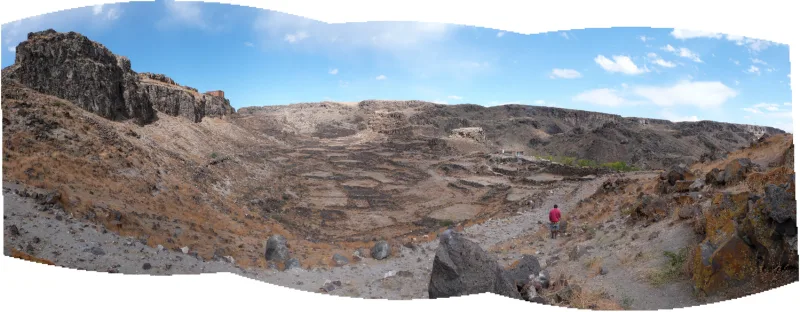
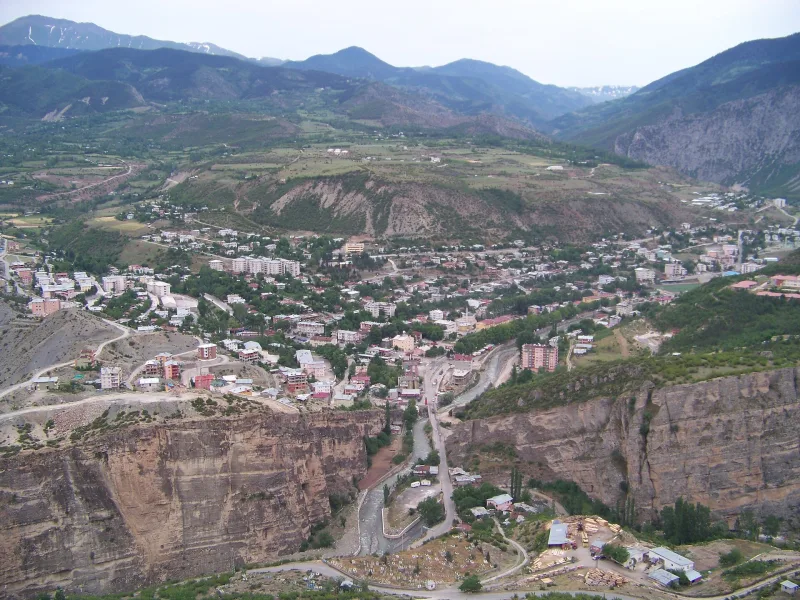
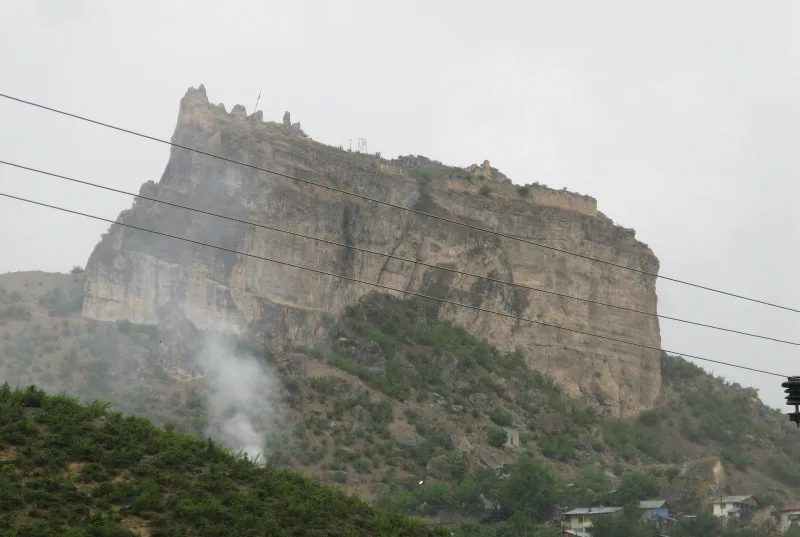
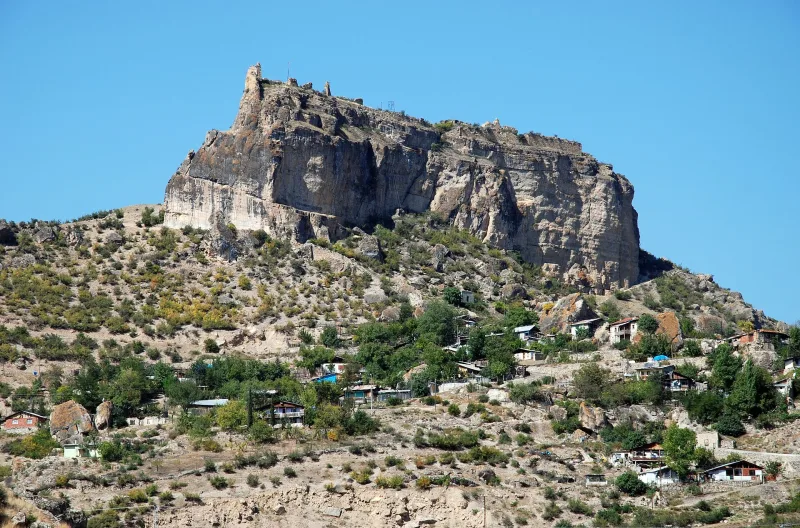
Artanuji (Turkish: Ardanuç Kalesi, Georgian Artanuji Tsikhe) is one of the most impressive medieval fortresses in northeastern Turkey, perched on a sheer cliff above the river of the same name in Artvin Province. Once upon a time, it was not just an outpost, but a fortress city, the capital of the Georgian principality of Tao-Klarjeti and a crossroads of caravan routes between the Black Sea and Persia. Today, all that remains of that former glory are 220 meters of ruined walls, the skeleton of a single-nave church, and the stone-cold silence over the valley. But it is precisely this silence that makes Artanuji so memorable: you climb the trail to the flat summit of the rock and find yourself in a first-class archaeological reserve, where the wind rustles the grass between the slabs, and below lies the village of Adakale—a direct descendant of the medieval city.
The History and Origins of Artanuji
According to the Georgian chronicle "Kartlis Tskhovreba," the fortress was built in the 5th century by order of King Vakhtang Gorgasali. He entrusted the work to his sister’s son, Artavan, whose name, according to one account, gave the place its name. It was one of the strongholds of Georgian Klarjeti—a historical region that then extended to the upper reaches of the Chorokh River and controlled the mountain passes.
In the 8th century, the fortress was destroyed during the Arab campaigns under the Umayyad caliph Marwan II, known in Georgian sources as “the Deaf.” Around 820, the Georgian ruler Ashot I Kuropalat discovered the abandoned fortification and undertook its restoration. The chronicler wrote that Ashot “discovered in Klarjeti, in the forest, a single rock where Vakhtang Gorgasali had first erected a fortress named Artanuji,” restored it, and built a new city at its foot. Thus, the revived fortress became the heart of the Tao-Klarjeti principality.
The 9th–10th centuries marked the city’s golden age. Situated on the trade route from the Black Sea to Persia, Artanuji prospered through silk, silver, spices, and crafts. In the 10th century, the Byzantine Emperor Constantine VII Porphyrogenitus left a detailed description of the city in his treatise “On the Administration of the Empire”—a rare honor for a provincial center. After the unification of Georgia in the 11th century, the capital moved first to Kutaisi, then to Tbilisi, and the once-glorious trading city gradually turned into a provincial hub governed by an eristav.
In 1551, Ardanuch was besieged and captured by the troops of Sultan Suleiman the Magnificent from the Atabegs of Jakeli. From that moment on, the fortress became part of the Ottoman Empire and served as the administrative center of the sanjak. Somewhere within the city limits, a mausoleum with a rough stone dome has survived—the burial place of Sefer and Yusuf Pasha, as well as Ali Pasha, the Ottoman mutasarrif of the Ardanuch sanjak. In September 2021, archaeological excavations began here under the direction of Osman Aitekin; the work focuses on the Ottoman and Russian periods of the monument’s history.
Architecture and What to See
The fortress-city of Ardanuch is simple yet imposing in design: the main fortification stands on the flat summit of a massive rock, and to the northwest of it lies the settlement of Adakale—an ancient urban quarter that once existed under the protection of the walls. Today, the territory of the fortress and Adakale holds the status of a first-class archaeological monument.
Outer and Inner Fortress
Artanuji consists of two parts—the outer fortress and the inner citadel. The total length of the fortifications along the top of the rock reaches 220 meters, and the width at its widest point is about 55 meters. Most of the structures are heavily damaged: only isolated sections of the walls, fragments of the fence, and the ruins of buildings inside have survived to the present day. But even from these remains, it is clear how the architects utilized the terrain: the walls literally extend the rock, transforming the natural outcrop into a single defensive structure.
St. Peter and Paul Church inside the fortress
The main surviving building within the walls is a single-nave church known as the Peter and Paul Church (Petre-Pavle Kilisesi). It is built of white, unprocessed stone quarried directly from the rock beneath the fortress; the masonry includes blocks measuring one by two meters. The eastern apse has survived to a height of 2–3 meters. The roof has not survived, but traces of plaster and blue paint are visible on the interior walls—evidence that the church was decorated with frescoes. A small annex adjoins the northern side of the church. A princely palace once stood nearby, of which only the foundations remain.
Artanuci Church in Adakale
The second significant church is not located within the walls, but in the old city quarter of Adakale, at the foot of the cliff. It is known as the Artanuci Church (Artanuci Kilisesi) and belongs to the same Georgian medieval period as the fortress. For lovers of early Christian architecture, a visit to Adakale is just as important as the climb to the top: it was here that most of the townspeople lived, traded, and prayed while political events unfolded within the walls.
View from the cliff
The climb to the fortress itself is a highlight in its own right. The trail winds up a rocky slope, gradually revealing views of the narrow Ardanuch River valley, green terraces, and the rooftops of the modern village. At the top, on a flat area above the cliff, it becomes clear why Vakhtang Gorgasali chose this particular rock: on three sides—sheer walls; on the fourth—a narrow approach that is easy to block. Before your eyes lies a scene typical of northeastern Anatolia: a winding river valley, the forested slopes of the Pontic Mountains, and traces of ancient terraced fields. On a clear day, this view is easily comparable to the vistas of the Caucasus Range from Russian foothill fortresses—the same geometry of gorges and cliffs, only with a Georgian architectural style.
Interesting facts and legends
- In Turkish sources, the fortress is known by a second name—Gevhernik. The name derives from the Persian “Gevher-i Nik,” meaning “beautiful pearl”: “gevher” means a precious stone or pearl, and “nik” means “good, pleasant.” An eloquent nickname for a city that grew rich through trade.
- The Byzantine Emperor Constantine VII Porphyrogenitus dedicated a separate section of his treatise “On the Administration of the Empire” to Artanuji—a rare instance in which a provincial fortress received attention at the level of the Constantinopolitan court.
- According to Georgian legend, Ashot I Kuropalat found a rock in a remote forest and recognized it as the ruined fortress of Vakhtang Gorgasali: thus, in the 9th century, the monument was given a new lease on life and became the capital of the principality of Tao-Klarjeti.
- Inside the Church of Saints Peter and Paul, traces of blue paint on the plaster are still visible—evidence that the walls were once covered with frescoes; without restoration, this fragile layer is gradually disappearing.
- Archaeological excavations, which began in 2021, are officially focused on the Ottoman and Russian periods: this demonstrates just how complex the historical memory of Klarjeti is, where Georgian, Byzantine, Ottoman, and Russian layers are intertwined on a single rock.
How to get there
The fortress is located approximately 1 km from the village of Ardanuç, the administrative center of the district of the same name in Artvin Province. Ardanuç itself is situated 35 km southeast of the city of Artvin, in the valley of the Ardanuç River—a tributary of the Chorokh. The most convenient way to reach Artvin is to fly via Kars (KYS) or Erzurum (ERZ) airports—both serve domestic flights from Istanbul and Ankara. The distance from Kars to Artvin is about 240 km, and from Erzurum—about 220 km; the road winds through picturesque mountain serpentines.
Dolmus (minibuses) run from Artvin to Ardanuç from a small bus station in the center; the trip takes about 45–60 minutes. For drivers, it is more convenient to rent a car in Erzurum or Kars and include several sites in the Tao-Klarjeti region in the itinerary: Artanuji, Ishkhani, Dolishkhan, and Tbeti. From the village to the trailhead leading to the fortress is a short walk, with the final 15–20 minutes involving an ascent along a rocky path. There is no ticket office; admission is free, but the area is considered an archaeological site, and straying from the trails is not recommended.
Tips for travelers
The best time to visit is spring (May–June) and early fall (September–October). In summer, the Ardanuch Valley gets very hot, the rock becomes scorching, and there is almost no shade on the trail. In winter, roads in the mountainous regions of Artvin are often closed due to snow and mudslides, so most visitors come here from May through October. The best lighting for photography is early morning and late evening: that is when the texture of the white stone and the rock’s relief are most visible.
Wear only closed-toe shoes with treads: the marble and limestone slabs on the trail are slippery after rain. Bring water, a hat, sunscreen, and a light windbreaker—strong winds often blow at the summit, even in warm weather. Allow 1.5–2 hours to explore the fortress and descend to Adakale; if you plan to fully visit both the Peter and Paul Church and the Artanuch Church at the foot of the hill, allow 2.5 hours. In the village of Ardanuch, there are several simple cafes serving regional cuisine: be sure to try the local cheese, cornbread, and mukhlama—a Black Sea corn and cheese stew.
The Artvin region pairs perfectly with a tour of the Georgian churches of Tao-Klarjeti: Ishkhani, Dolishkhana, Parkhali, and Oshki. All these sites are within a 60–100 km radius of Artanuji, and together they form a logical three- or four-day tour of medieval Georgia within modern-day Turkey. Keep in mind that this is a border zone, and for trips to remote valleys, it’s sometimes worth checking with the local gendarmerie to see if there are any temporary restrictions. Don’t forget a paper map or offline navigation: cell service in the Artvin gorges is spotty. Artanuji isn’t the kind of attraction where you walk around with an audio guide in your ears; people come here for the feeling of the bare rock, the wind over the valley, and the presence of all those eras that left their stones here.