Side: An Ancient Seaside City with the Temple of Apollo
Side is a remarkable ancient city on a small Mediterranean peninsula, where ancient ruins stand side by side with modern restaurants and shops. This archaeological site in the province of Antalya offers a combination rarely found in Turkey: a stroll through Roman streets, swimming on white-sand beaches, and a sunset over the Temple of Apollo—one of the most photographed views in Pamphylia. Ancient Side attracts travelers year-round and is rightfully included on the list of must-visit places on the Turkish Riviera.
Unlike many other ruins, where you need to buy a ticket and follow a museum route, the old town of Side is open and free: you simply stroll through it as you would any ordinary neighborhood. Tickets are only required for the ancient theater and the local museum.
History and Origin
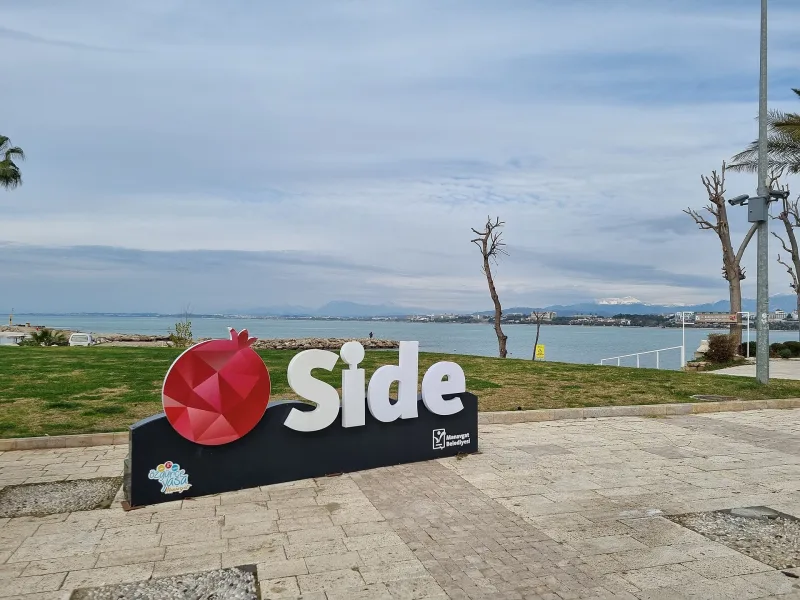
According to one hypothesis, the city’s name translates from the ancient Anatolian language as “pomegranate”—a fruit that still symbolizes Side today. The city was founded by Greek colonists from Aeolian Cima around the 7th century BCE, but within a few generations, the new residents had forgotten Greek and began speaking the local “Sidean” dialect—one of the enigmatic languages of ancient Anatolia. It is precisely this moment of linguistic assimilation that still sparks debate among researchers: exactly how did the Greek colonists lose their own language in favor of the local dialect? Some suggest intermarriage, others—active integration into the regional trade network.
In the 4th century BCE, Side surrendered without a fight to Alexander the Great. After the general’s death, the city fell under the control of the Ptolemies, then the Seleucids, and in 190 BCE, a naval battle took place off its shores in which the Rhodian fleet, under the command of Eudamus, routed the Seleucid forces led by the legendary Carthaginian Hannibal Barca.
This battle was of immense significance for the entire Mediterranean—it cemented Rome’s control over the eastern sea lanes and effectively ended Hannibal’s career as a naval commander. Side found itself an unwitting witness to one of the turning points of ancient history.
In the 2nd–3rd centuries CE, having become part of the Roman Empire, Side experienced its golden age. The city grew wealthy through trade in olive oil, wine, and—unfortunately—people: Side was one of the largest slave markets in the eastern Mediterranean. At its peak, the population exceeded 60,000 people. In the 4th–5th centuries, following Christianization, the city became the seat of a metropolitan bishop. Arab raids in the 7th century, earthquakes, and the gradual silting up of the harbor led to its decline, and by the 10th century, Side was practically abandoned. It found new life only in the 19th century, when Muslim Turks from Crete moved here, having fled the island following the Greek-Turkish population exchange. It is their descendants who make up the current population of the old town, and it is thanks to them that Side does not look like a sterile museum—it is a living village with fishermen, artisans, and cafes where elderly people speaking a mixture of Turkish and Cretan Greek might be sitting at the next table. This rare blend of history and modern life makes Side unique among Turkey’s ancient sites.
Architecture and What to See
Ancient Side is located on a tiny peninsula about 800 meters long and 350 meters wide. You can walk around all the key monuments in 2–3 hours. What makes the town unique is that the ancient ruins here aren’t separated into a separate ticketed area—they’re literally intertwined with modern buildings. You can step into a shop whose windows are Roman columns, or sit in a café built around a fragment of an aqueduct. It is precisely this “living archaeology” that sets Side apart from other ancient cities in Turkey.
Temple of Apollo
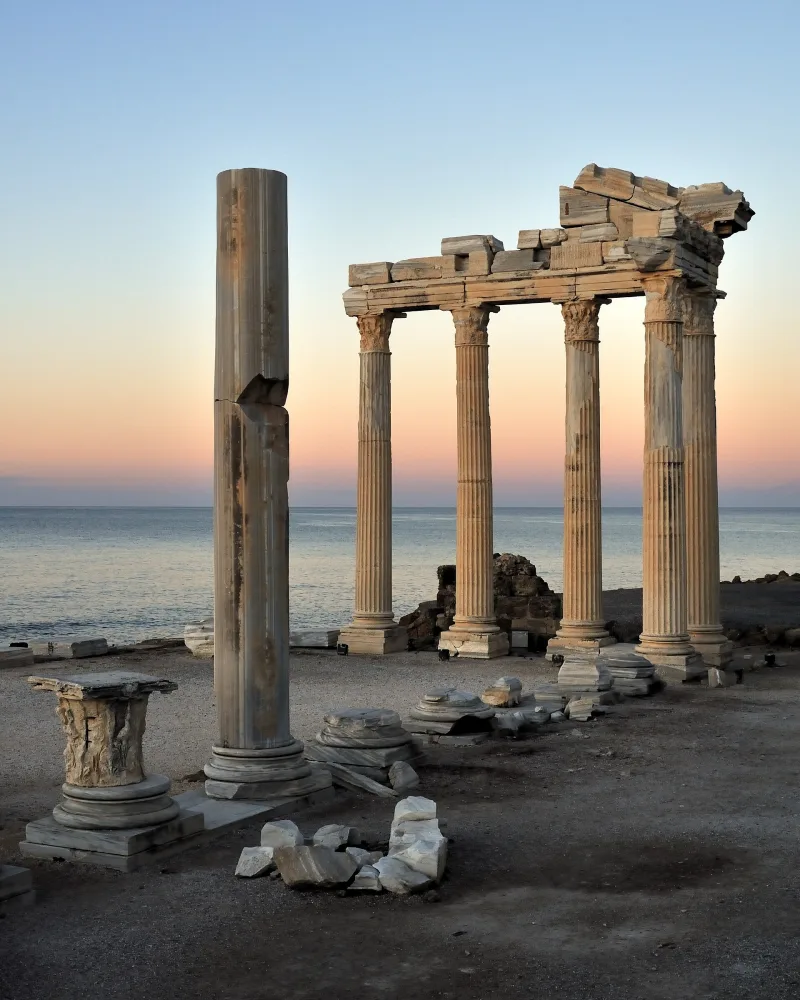
Side’s main attraction is the 2nd-century AD Temple of Apollo. Its five white marble Corinthian columns, restored in the 1980s, rise directly on the seashore. The temple looks particularly striking at sunset, when the stone is bathed in shades of pink and gold. Nearby stood the Temple of Athena, of which only the foundation remains. Admission is free, and the site is open 24 hours a day. In antiquity, these two temples, standing side by side on the sacred precinct (themenos) by the sea, formed a majestic ensemble that sailors saw immediately upon approaching the harbor—as a symbol of the city’s protection and prosperity. Today, this very view has become one of the most recognizable images of the Turkish Mediterranean.
Ancient Theater
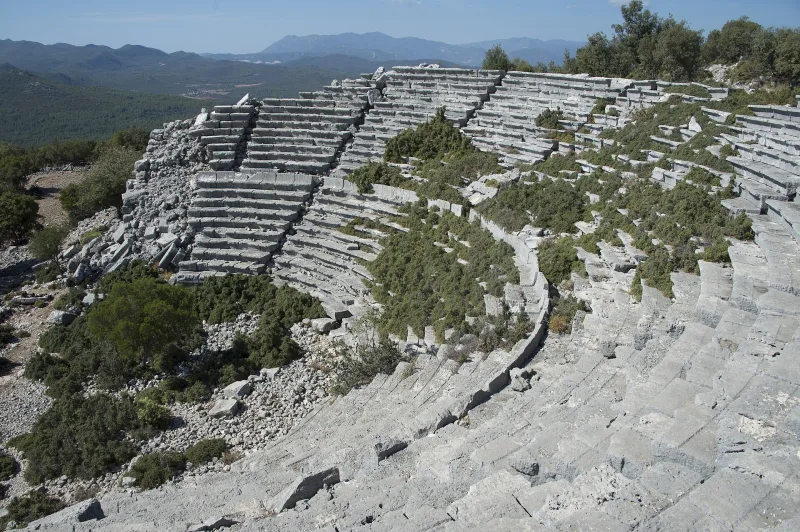
The Side Theater is one of the largest in Asia Minor, with a capacity of 15,000–17,000 spectators. Unlike the theater in Aspendos, the cavea here was not built into a slope but rested on massive arched substructures, as the terrain is flat. During the Roman period, the theater was also used for gladiatorial combat. In late antiquity, it was converted into an open-air Christian basilica.
The Agora and the Slave Market
Opposite the theater lies the agora—the central marketplace with the circular Temple of Tyche (Fortuna). It is here, according to archaeologists, that the infamous slave market took place. Nearby are public toilets with preserved marble seats, one of the finest examples of Roman domestic architecture.
City Walls and Towers
Side was surrounded by a massive fortress wall with eight towers, built in the 3rd century CE when the city began to face threats from Gothic naval raids. Fragments of the walls have survived along the perimeter of the peninsula, and on the eastern side, you can see a well-preserved square tower with loopholes. The walls offer a magnificent view of the sea and the entire old town, and at night they are spectacularly illuminated.
City Gates and Colonnaded Street
The main entrance to the ancient city leads through a two-story city gate from the 2nd century, beyond which the famous colonnaded street begins. Shops and porticoes lined both sides, and in the center stood an aqueduct that brought water from springs 30 kilometers from the city.
Byzantine Basilica and Museum
Behind the thermal baths (Byzantine era) lies the Side Archaeological Museum—one of the best in Turkey. It houses an excellent collection of Roman sculptures, sarcophagi, and mosaics, including the famous “Three Graces” and sculptures of Hermes and Nike. The museum is housed in the building of the former Roman baths, which makes the visit even more atmospheric.
Aqueduct and Monumental Fountain
At the entrance to the old city, next to the city gates, stand the impressive remains of a monumental nymphaeum fountain from the 2nd century CE. It was supplied with water via an aqueduct about 30 kilometers long, which began in the Taurus Mountains. From the surviving fragments, one can reconstruct a three-tiered structure with niches for statues and stone dolphins spouting water. This is where the ceremonial entrance to ancient Side began.
Eastern Necropolis
Beyond the walls of the old city, along the road leading east, a Roman necropolis has been preserved, featuring dozens of sarcophagi and family mausoleums. Many of them are decorated with reliefs depicting mythological scenes—from Dionysus to the Amazons. This is a relatively off-the-beaten-path part of Side that most tourists skip, but it offers a completely different perspective on the size and wealth of the ancient city.
Interesting Facts and Legends
- Pomegranates—one of the oldest urban symbols of the Mediterranean—were often depicted on Side’s coins.
- A unique local alphabet (“Sidean”) was discovered in the city, only partially deciphered—a rare example of ancient Anatolian writing.
- According to legend, Hannibal committed suicide in Side, unwilling to surrender to the Romans, but it is only known for certain that he visited here before his final flight to Bithynia.
- In the evening, the colonnaded street is illuminated by spotlights, creating the feeling of a theatrical set.
- At night, street musicians often gather around the Temple of Apollo, turning a stroll into an impromptu concert.
- In the 3rd century CE, Side was ravaged by the Goths, who plundered temples and homes. The city never fully recovered from this invasion, although it retained its status as a diocese during the Byzantine period.
- One of the mosaics from the Side Museum depicts the philosopher Anacharsis—a Scythian whom the ancient Greeks credited with wisdom comparable to that of the Seven Sages. This is a rare example of a “barbarian” hero in Roman art.
How to get there
Side is located 75 km east of the center of Antalya, in the Manavgat district. The nearest international airport is Antalya (AYT), from which it is about a 1-hour drive by taxi.
By car: Take the D400 highway toward Manavgat/Alanya, then turn toward Side. Parking at the entrance to the old town is paid. Vehicle traffic is restricted within the peninsula.
By bus: buses depart from the Antalya bus station (otogar) to Manavgat every 30 minutes; from there, take a dolmuş to Side (about 10 minutes). Total travel time is approximately 1.5–2 hours.
Sightseeing buses run from the coastal resorts of Belek, Kumluji, Side, and Alanya, often including a combined visit to Aspendos and the Manavgat Waterfall.
Tips for travelers
Side is unique in that it combines archaeology with a beach vacation. In the morning, you can stroll through the ruins; in the afternoon, swim in the bay at East Beach; and in the evening, return to the Temple of Apollo for sunset. Bring a swimsuit, even if you originally planned only a sightseeing trip.
The best seasons are April–June and September–October. It gets very hot in the summer, and most of the ancient ruins have no shade. The town is also beautiful in the winter, but many shops and restaurants close.
To photograph the Temple of Apollo, plan to arrive 30–40 minutes before sunset: during the “golden hour,” the color of the marble changes every minute. The best vantage point is from the pier on East Beach.
Entrance to the old town is free, but you have to pay for the theater and museum. The Turkey Museum Card (Müzekart) is valid here. If you plan to visit several ancient sites, it quickly pays for itself.
Be prepared for the fact that Side has many souvenir shops and cafes geared toward tourists. Prices can be inflated, especially along the waterfront. The best restaurants are in the side streets, not on the main strip. Try the local grilled fish and pomegranate sherbet—in honor of the city’s symbol.
If you love photography, visit the Temple of Apollo twice—at sunset and before sunrise. At sunset, you’ll be joined by a crowd of tourists, while before sunrise, there will be only one or two fishermen on the pier and an empty beach. Before dawn, the light is softer, and the columns take on cool bluish tones, creating a completely different atmosphere.
Be sure to check out the famous Manavgat Waterfall, located 8 km upstream from Side. It’s one of the most popular side trips in the region. The waterfall isn’t very tall, but it’s wide and very picturesque, with a walking area and restaurants along the riverbank. You can easily spend half a day exploring both Side and the waterfall, especially if you’re traveling with kids.
On the way back, stop by the local Side Museum—it takes only 45 minutes but offers a whole new perspective on the ancient city. Here you’ll see what the statues that once stood in the temples and the agora looked like. Ancient Side is worth at least one leisurely day, and if the weather cooperates, it will become your fondest memory of Turkey.