Göbekli Tepe: Humanity’s Oldest Temple in the Hills of Şanlıurfa
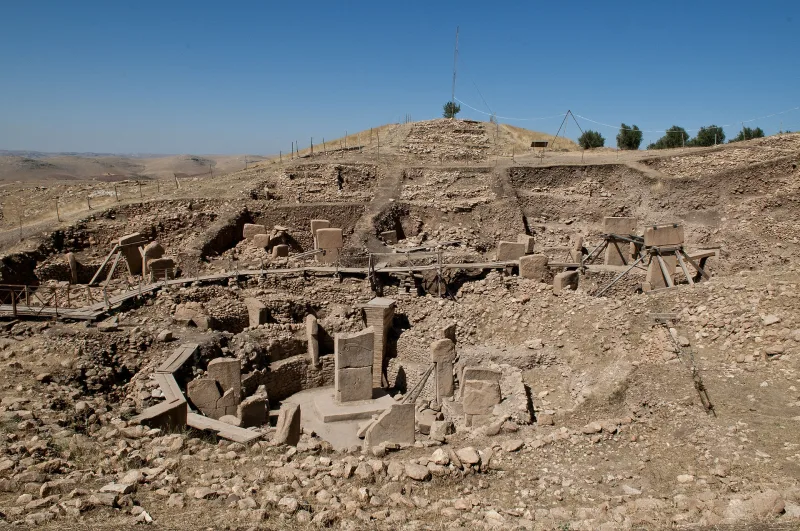
Göbekli Tepe is an archaeological site in Southeastern Anatolia that has completely revolutionized scientific understanding of the origins of civilization. Located on a low hill 15 kilometers from the city of Şanlıurfa, this complex of T-shaped megaliths, dating back approximately 11,500 years, is considered the oldest temple structure known to humanity. Göbekli Tepe is approximately six millennia older than Stonehenge and more than seven millennia older than the Egyptian pyramids. Its inclusion on the UNESCO World Heritage List in 2018 cemented its status as one of the most significant archaeological discoveries of the 21st century and made it a must-see destination for anyone interested in prehistoric archaeology, megalithic architecture, and early human history.
History and Origin
The mound was first spotted by a Turkish-American archaeological survey as early as 1963, but at the time it was mistaken for a medieval cemetery due to limestone fragments protruding from the ground. The true discovery took place in 1994, when German archaeologist Klaus Schmidt of the German Archaeological Institute re-examined the site and realized he was dealing with an intact pre-ceramic Neolithic monument. Systematic excavations began in 1995 and continue to this day under the direction of Turkish archaeologists and international partners.
Radiocarbon dating places the earliest structures at Göbekli Tepe around 9600 BCE, corresponding to the end of the last Ice Age. This means that the grandiose stone circles were built by hunter-gatherers even before humans mastered agriculture, domesticated animals, and fired the first clay pot. The discovery refuted the classical theory that complex ritual architecture could only have emerged after the Neolithic Revolution. Klaus Schmidt formulated a fundamentally new idea: perhaps it was the collective need for construction and ritual that drove people toward a sedentary lifestyle, rather than the other way around. The region’s first agricultural settlements later sprang up around Göbekli Tepe, and some researchers link the domestication of einkorn wheat to the communities that gathered around this sacred hill.
Construction took place in several phases over the course of about one and a half millennia. At some point around 8000 BCE, the complex was deliberately buried under earth and rubble—the reasons for this ritual “burial” remain a mystery to this day. It is precisely thanks to this layer of fill that the stone stelae have been perfectly preserved to the present day.
Over the past two decades, archaeological work on the hill and at the neighboring sites of Karahan-Tepe, Sayasy-Tepe, Köribtepe, and Tellereci-Tepe have shown that Göbekli Tepe was not an isolated wonder, but rather part of a large network of ritual and social centers from the Late Upper Paleolithic and Early Neolithic periods in Southeastern Anatolia. These sites, grouped in scholarly publications under the project name “Taş Tepeler” (“Stone Hills”), demonstrate a striking unity of architectural language: T-shaped pillars, circular enclosures, and animalistic reliefs. This distribution suggests the existence of a cultural region with shared beliefs, ritual practices, and perhaps even proto-priesthood. Contemporary researchers particularly emphasize that Göbekli Tepe cannot be properly understood without taking this broader context into account. In addition, within the hill itself, so-called “small enclosures” have been identified—small square spaces that may have served individual ritual practices, while the large circles were intended for collective ceremonies, possibly linked to astronomical phenomena and seasonal migrations.
What to See and Architecture
Göbekli Tepe consists of a series of circular and oval enclosures, in the center of which stand massive T-shaped limestone pillars up to 5.5 meters high and weighing up to 16 tons. Additional, slightly smaller columns are arranged along the perimeter of the enclosures, incorporated into a stone bench-wall. Today, four main enclosures are open to visitors, provisionally designated by archaeologists as A, B, C, and D, while the total number of such structures identified by geomagnetic surveys exceeds twenty.
Enclosure D — the heart of the complex
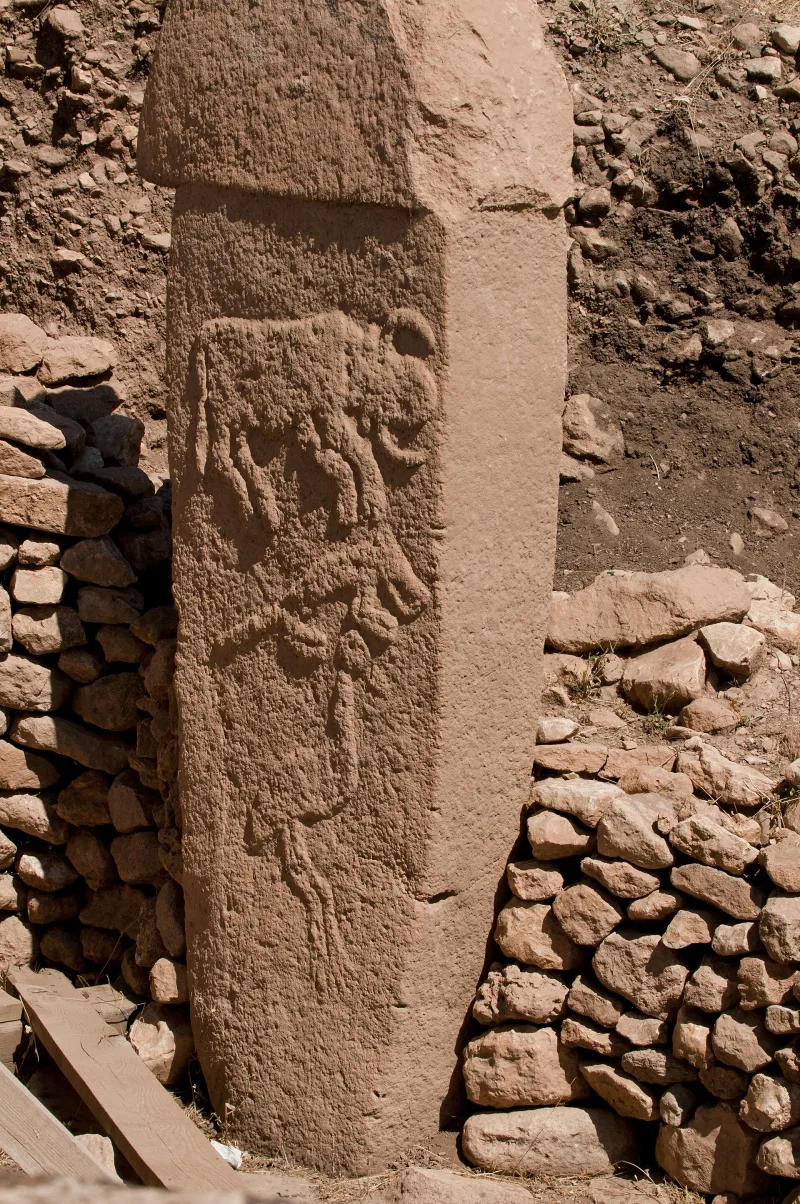
The most impressive and best-preserved Enclosure D showcases the full artistic scope of Neolithic craftsmen. Its central posts are decorated with bas-reliefs of foxes, snakes, wild boars, cranes, scorpions, and spiders. The T-shaped form of the posts is interpreted as a stylized human figure: on some columns, arms, a belt, and even a loincloth can be discerned. This suggests that these are not merely supports, but anthropomorphic depictions of ancestors, deities, or mythological heroes.
Archaeological Park and Protective Covering
Since 2018, a modern tent-like canopy made of laminated wood and membrane fabric has been erected over the excavation site, protecting the fragile limestone from rain and sun. Visitors walk along specially laid wooden walkways, which offer panoramic views of both main excavation fields. The trail is designed to provide several key viewing platforms, allowing visitors to appreciate the scale and details of each fence.
Şanlıurfa Archaeological Museum
A visit to Göbekli Tepe is best combined with a visit to the Şanlıurfa Archaeological Museum, located in the city. It features authentic bas-reliefs, the “Urfa Man” statue—the world’s oldest known full-length depiction of a human—and a life-size reconstruction of one of the enclosures. Without a visit to the museum, the picture of the region’s Neolithic world remains incomplete.
Enclosures A, B, and C
In addition to the impressive Enclosure D, visitors can see three other large structures. Enclosure A features stelae with reliefs of snakes and arachnid creatures; Enclosure B is known for a stela depicting a fox on the belt of an anthropomorphic pillar; and Enclosure C stands out for its scale: its central columns are among the most massive ever found. The wooden walkways are designed so that visitors can systematically compare the styles of the reliefs and the artistic styles of the various “schools” of sculptors who worked at Göbekli Tepe during different periods of the complex’s existence. The trail also allows visitors to appreciate the scale of the quarries and imagine how multi-ton blocks were moved to their installation sites. According to researchers’ estimates, transporting a single pillar alone could have required up to 500 people working simultaneously, which in itself speaks to the complex social organization of hunter-gatherer societies.
Interesting Facts and Legends
- The name “Göbekli Tepe” translates from Turkish as “Potbelly Hill”—this is how local farmers referred to the distinctive rounded shape of the hill long before its scientific discovery.
- The pillars were carved from solid limestone rock in a quarry located just a few hundred meters from the complex. One of the unfinished stelae, weighing about 50 tons, still lies in the quarry—it was never separated from the parent rock.
- Carved images of foxes are the most common and, according to archaeologists, may have served as a totem or guardian spirit for one of the building communities.
- One of the stelae bears an unusual symbol resembling a handbag with a handle; similar “bags” appear in the iconography of ancient cultures in Mesopotamia, South America, and New Zealand, giving rise to numerous alternative hypotheses.
- According to Klaus Schmidt, Göbekli Tepe functioned as a regional ritual center where various groups of hunter-gatherers converged, and it was precisely the need to feed the builders that may have prompted them to experiment with wild wheat.
How to get there
The main transportation hub for the trip is the city of Şanlıurfa, which is most conveniently reached by domestic flight from Istanbul or Ankara to GNY Airport (Şanlıurfa GAP). The monument is about 18 kilometers from the city center along a good paved road; the taxi ride takes 25–30 minutes. During the summer season, regular shuttle buses run from the central bus station to the archaeological park. At the entrance, there is a large parking lot, a ticket office area, and a visitor center featuring a short film about the excavations. A small electric shuttle runs from the visitor center to the excavation site, as the walk uphill under the open sun can be tiring. For travelers from Europe and CIS countries, a connecting flight via Istanbul or Ankara is convenient: domestic flights in Turkey are inexpensive and frequent, and Şanlıurfa Airport is equipped with all the necessary infrastructure for international tourists. Renting a car in Şanlıurfa allows you to flexibly combine Göbekli Tepe, Harran, Karahan Tepe, and neighboring sites into a single trip, and if desired, continue on to Diyarbakır, Mardin, or even Mount Nemrut, as southeastern Turkey is well-connected by good highways.
Tips for Travelers
The best time to visit is spring (April–May) and fall (September–October), when temperatures remain within a comfortable range of 18–26 °C. In summer, temperatures in Southeastern Anatolia easily exceed 40 °C, so in July and August, it’s best to arrive either early in the morning, right at opening time, or closer to sunset. Bring a hat, sunscreen, and at least one liter of water per person, even though there is a small café on site.
Allow about 1.5–2 hours to explore the excavations themselves, including all viewing platforms. If you plan to combine your visit with the Şanlıurfa Archaeological Museum and a walk to the sacred Balyklygöl ponds in the city center, you’ll need about 6–8 hours for the entire day. Please note that photography inside the excavation site is permitted, but the use of drones requires separate approval from the administration. Don’t forget to wear comfortable, closed-toe shoes—the wooden walkways are quite comfortable, but the ground around them is rocky and loose in places. During the summer season, it’s a good idea to bring wet wipes and a portable fan, and in the off-season, a light windbreaker will come in handy, as the steppe wind often blows across the open plateau. The café at the visitor center offers drinks, light snacks, and local souvenirs, including high-quality photo albums and popular science books about the site.
When planning your trip, keep in mind that Göbekli Tepe is constantly evolving as a tourist destination, and opening hours, ticket prices, and visiting rules change periodically—it’s worth checking the official website of the Turkish Ministry of Culture and Tourism before your visit. Experienced travelers recommend hiring a local guide or researching the history of the excavations beforehand, because without context, the T-shaped pillars may seem less impressive than they actually are.
For a deeper immersion, I recommend combining your trip with a visit to the neighboring “Stone Hills” sites—most notably Karahan Tepe, which opened to visitors in the early 2020s and offers a glimpse of another large Neolithic temple complex featuring beautifully preserved anthropomorphic figures. In Şanlıurfa, be sure to stroll through the old quarter, visit the famous sacred Balyklygöl ponds with their carp—legendarily linked to the prophet Abraham—and the traditional Kapalı Çarşı covered market. The city offers excellent regional cuisine: try çı köfte, lahmacun, mengi pilav, and especially the local pistachio ice cream. The best hotels are located in historic caravanserais converted into boutique hotels, and spending the night in such a setting is, in itself, a small journey back in time. It is precisely the realization that you are standing before a temple built by hunter-gatherers millennia before the invention of the wheel and writing that transforms a visit to Göbekli Tepe into an unforgettable journey to the origins of human civilization and one of Turkey’s most significant attractions.