Ankara Castle—a fortress that has stood witness to twenty-six centuries, perched on a hill above Ankara
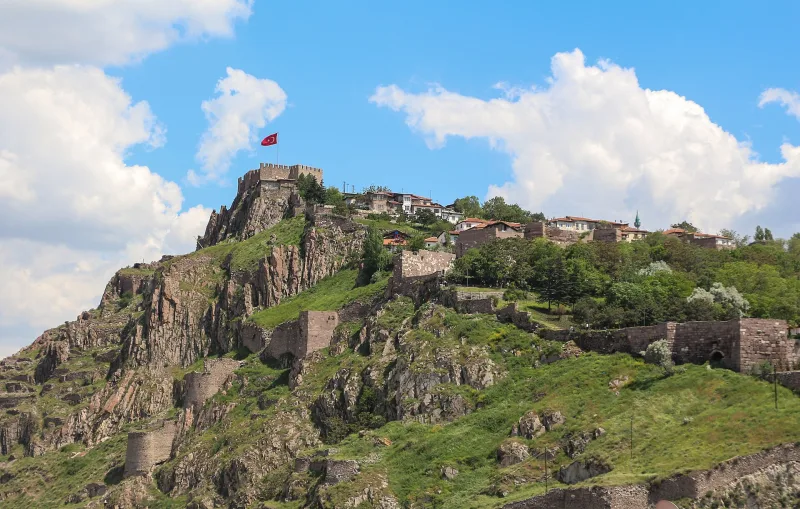
As you climb the narrow streets of the old town of Altındağ and Ankara Castle suddenly looms before you, a strange sensation arises: as if the city beneath your feet is merely a backdrop, and the true capital has always been here, atop the cliff. Ankara Castle, or Ankara Kalesi, is not merely a historical monument of Central Anatolia, but a layered stone in which the Phrygians, Galatians, Romans, Byzantines, Seljuks, and Ottomans have left their mark. Inner walls up to sixteen meters high, forty-two pentagonal bastions, the eastern Akka Tower, and thick blocks of marble embedded directly into the masonry alongside Roman columns make this fortress one of the country’s most eloquent archaeological sites. From here, 110 meters above the plain, you get the best view of Ankara and the best way to understand it.
History and Origins of Ankara Castle
The history of Ankara Castle is generally traced back to the 8th century BCE, when the Phrygians built the first fortification here on a rocky peak overlooking the plain. The location was ideal: the hill dominates the valley, the slopes are steep, water is nearby, and the view stretches for tens of kilometers in all directions. In 278 BCE, the Galatians—Celtic tribes who had come from Europe and settled in central Anatolia—rebuilt the fortress and made it the stronghold of their new homeland. It was from the Galatians that the region received the name Galatia, and the citadel itself was first constructed entirely of stone.
From the second century BCE, the city became part of the Roman Republic, grew rapidly, and expanded beyond the fortress walls. In 217, Emperor Caracalla ordered the dilapidated walls to be restored, but by the middle of the third century, under Emperor Alexander Severus, the fortress was partially destroyed by the Persians. A truly large-scale reconstruction began in the second half of the seventh century, when the Roman-Byzantine city of Ankara was recovering from the devastating blow of 622—the capture and sacking of the city by the Sassanid Persians. According to historian Clive Foss, the inner walls date back to this era: they were likely built during the reign of Emperor Constans II.
The Byzantines did not stop there. Emperor Justinian II erected the outer wall in 668; Leo III repaired it in 740 while simultaneously raising the height of the inner fortifications; and Nikephoros I in 805 and Basil I in 869 continued the fortifications. Each of these renovations added a new course of masonry, new brick inserts, and new inscriptions, so that today archaeologists read the fortress like a geological cross-section: the higher the layer, the later the date.
In 1073, the fortress fell into the hands of the Seljuks; in 1101, it was briefly captured by the Crusaders of the First Crusade; and in 1227, it finally returned to the Seljuks. Sultan Alaeddin Keykubad I carried out another round of repairs, and in 1249, Izzeddin Keykavus II added new extensions, including towers and sections of the parapet. The last major reconstruction dates back to 1832: by order of the Egyptian governor Ibrahim Pasha Kavala, the outer walls were expanded, and the fortress has survived to this day in this form—a witness to the succession of six civilizations on a single rock.
Architecture and What to See
The architecture of Ankara Kalesi is a textbook example of how entire eras overlap. The fortress is divided into two parts: the inner citadel at the very top and the outer ring of walls that once surrounded the old city. The inner fortress is a compact quadrangle measuring approximately 350 by 180 meters (according to English Wikipedia, 350 by 150 meters), with an area of about 43,000 square meters. The outer line winds down the slopes below and has survived only in fragments, but still shows just how large the medieval city was.
Walls, towers, and pentagonal bastions
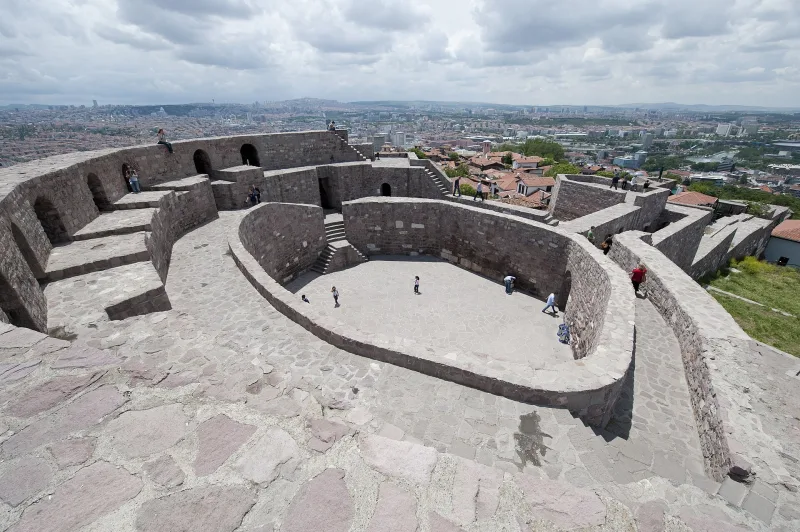
The most impressive feature of the fortress is the rhythm of its bastions. Along the eastern, western, and southern walls, a pentagonal projection rises every fifteen to twenty meters. There are forty-two such bastions in total, and it is they that define the silhouette recognizable from any panoramic vantage point in Ankara. The walls range in height from fourteen to sixteen meters; the lower section is built of marble and basalt, while the upper section is made of local Ankara stone and brick. The outer ring features about twenty towers, spaced more widely—roughly every forty meters.
Akkaale, the Gate, and Seljuk Inscriptions
In the southeast corner of the inner fortress stands Akkaale—the “White Fortress”—the highest point of the complex. From its upper terrace, the city looks like a model, and on a clear day, the outskirts of Çankaya and the silhouettes of distant hills are visible. Two gates lead into the citadel: the outer and inner gates, known as Hisar Kapısı. An Ilkhanid Arabic inscription has been preserved on the lintel, and in the northwestern section, Seljuk epigraphy is visible, directly documenting the dynasty’s contribution to the reconstruction. These stones literally speak—you just have to look closely.
Spolia: A Second Life for Roman Monuments
The most touching detail of Ankara Castle is its spolia. Fragments of Roman buildings are embedded in the masonry: capitals of Corinthian columns, pieces of sarcophagi, marble gutters from old aqueducts, and fragments of statues and tombstones. In the eighth and ninth centuries, when the city suffered repeated raids, the builders had no time for aesthetics—and they quickly assembled the fortress walls from whatever lay nearby, from the ruins of imperial Ankara. Thanks to this utilitarian haste, the fortress became an accidental stone museum of antiquity, where the Roman era has literally grown into the Byzantine masonry.
The Inner City and Panoramas
Life within the walls of Ankara Kalesi has never ceased. Here, even today, stand old Ankara houses with wooden bay windows, narrow alleys lined with tea houses, small mosques, and coppersmith workshops. The fortress has long ceased to be merely a museum—it is a residential neighborhood with a view, to which tourists ascend through the same double gate that once saw Seljuk garrisons pass through. Every year, the grounds host city festivals, concerts, and craft fairs, keeping the place alive. On summer evenings, the walls are illuminated by warm lanterns, and in the small souvenir shops near Hisar Kapısı, you can find copper trays, filigree items, and knitted woolen goods—crafts for which Ankara has been famous since the days when the famous Angora wool was produced here.
Interesting Facts and Legends
- Marble columns, capitals, and even fragments of sarcophagi are built into the fortress walls—all of these are “spolia” from the ruins of Roman Ankara, used as ordinary building material in the eighth and ninth centuries.
- The fortress changed hands so many times that its masonry physically encompasses the Phrygian, Galatian, Roman, Byzantine, Seljuk, and Ottoman eras—a rarity even for Anatolia with its rich history.
- According to legend, it was from here, from the heights of the citadel, that the Galatian chieftains first saw the valley they would name Galatia; later, the Byzantines claimed that on a clear day, one could see the smoke of distant signal fires from Akka.
- The thickness of the walls and the use of pentagonal bastions made the fortress virtually impregnable: during the siege of 1101, the Crusaders were able to capture it only briefly, and by 1227 the Seljuks had regained control of the citadel.
- The last major restorer of the fortress was neither a sultan nor an emperor, but the Egyptian governor Ibrahim Pasha Kavallali—in 1832, he expanded the outer walls during his brief rule over Anatolia.
- Locals say that every era has left its “signature” on the walls: the Ilkhanid inscription above the Hisar Gate and the Seljuk epigraphy in the northwestern section directly document the dynasties’ contributions to the reconstruction—a rare instance where builders themselves signed their work.
- Today, the fortress hosts annual city festivals and craft fairs, meaning it continues to fulfill its ancient function—bringing the city’s life together around it, though now for cultural rather than defensive purposes.
How to get there
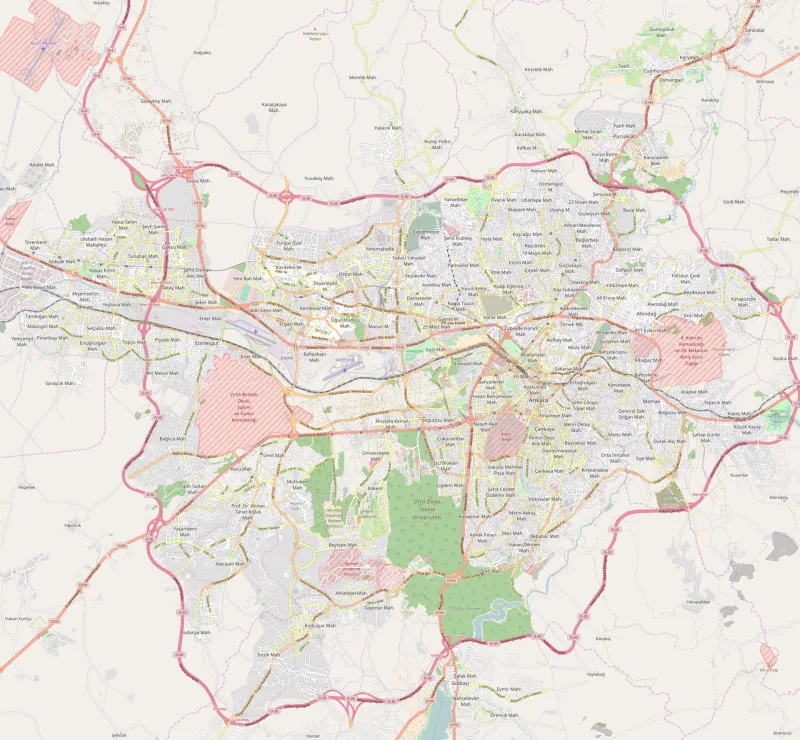
Ankara Castle is located in the Altındağ district, in the historic heart of Ankara, just a fifteen-minute walk from Ulus Square. The easiest way is to take the Ankaray or M1 metro line to Ulus Station, then walk up Hisar Parkı Street: the uphill walk takes about twenty minutes and turns into a tour of the old city with its Ottoman-style houses and artisan shops. If you don’t like walking uphill, you can take a taxi directly to the lower gates of the fortress—the ride from the city center is inexpensive and takes no more than ten minutes.
From Esenboğa Airport, the most convenient option is to take the Havaş bus to Kızılay Square, from where it’s a ten-minute taxi ride or a twenty-minute metro ride with a transfer to the fortress. For tourists arriving by train, it’s even easier: from the YHT station to the foot of the hill is about two kilometers, which can easily be walked in half an hour. On the way, it’s worth stopping by the Museum of Anatolian Civilizations—it’s located right at the entrance to the fortress and fits logically into the itinerary: first the context, then the site itself. For those arriving by car, it’s best to park at the lots near Ulus or the museum—the roads inside Altındağ are so narrow that passing another car becomes a challenge.
Tips for travelers
The best time to visit is spring (April–May) and fall (September–October), when Ankara is dry, the sun is mild, and the valleys around the city are painted in shades of green or gold. In summer, the plateau gets very hot, and in winter, the capital is known for its winds and rare but genuine snow—but the winter fortress is deserted and especially photogenic. Arrive at least an hour before sunset: at this moment, the walls glow copper-pink, and the panorama from Akka is like a postcard.
Footwear is the most important thing. The old cobblestones and stone steps inside the fortress are uneven and slippery, especially after rain, so hiking boots or sneakers with good traction are a must. Admission to the grounds is free, and the visit itself takes between an hour and a half and two hours if you take your time. Plan a combined visit: first, the Museum of Anatolian Civilizations at the foot of the hill, then a walk up Hisar Park with a cup of tea at one of the traditional tea houses, and only then—the citadel itself and Akalle. For dinner, head back down to Hamamye—a restored neighborhood of Ottoman houses where they serve Ankara-style kofte and the famous Beypazarı tarhana soup.
For Russian-speaking travelers, the fortress becomes something of an Anatolian counterpart to the Kolomna or Pskov Kremlin—a place where material history is written in stone, and where a single ascent takes you on a journey from the Phrygian 8th century to the Ottoman 19th. Don’t forget water, sunscreen in the summer, and a warm jacket in the winter: the wind on Akka is biting. And most importantly—don’t rush to the top. Ankara Castle reveals itself slowly: in the spolia, in the Seljuk inscriptions, in the views of the valley, in the bustle of the old city beyond the walls—and it is precisely this unhurried pace that transforms the short climb up the hill into one of the most profound impressions of Ankara.