Corycus (Kızkalesi): Two Castles on the Shore and in the Sea of Cilicia
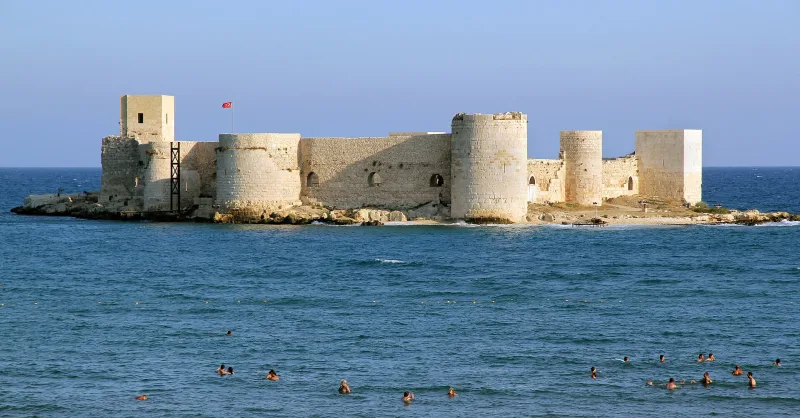
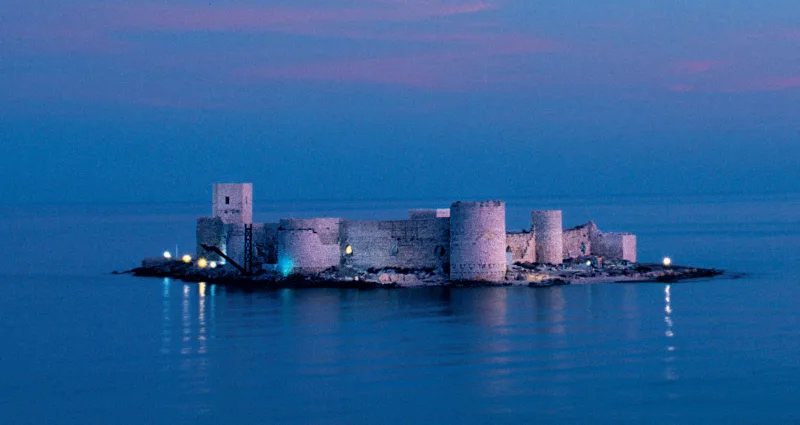
On the coast of Mersin Province, in the village of Kızkalesi (“Maiden’s Castle”), 60 km southwest of the center of Mersin, stand two medieval fortresses—one on the shore and one at sea—once connected by a stone pier. This is the ancient Corycus—the ancient port of Cilicia Trachea, an important stronghold of the Armenian Kingdom of Cilicia, and a Byzantine and Crusader outpost. The sea fortress on a small island 200 meters from the shore is one of the most striking silhouettes in the Eastern Mediterranean and the region’s main tourist attraction.
History and Origins of Corycus
The city emerged during the Hellenistic era as the port of Seleucia ad Calycadnum (modern-day Silifke). Corycus had its own mint, and its inhabitants were governed by “ancient laws”—a fact that underscored its autonomous status. In Cilicia Trachea—“Rough Cilicia”—Corycus was one of the few reliable harbors.
During the Byzantine era, the city underwent significant development: Justinian I restored public baths and a hospital here. In the 12th century, Admiral Eustathius Kimenianos rebuilt the island fortress as part of a program to fortify the Cilician coast.
At the end of the 12th century, Corycus passed to the Armenian Kingdom of Cilicia, which held both fortresses until 1360. The Armenians expanded and rebuilt both citadels; their masonry still bears the distinctive polygonal blocks and inscriptions. After the fall of Armenian rule, the fortresses successively passed to Peter I of Cyprus, the Karamanids, the Mamluks, and finally the Ottomans.
In the late Ottoman period, Corycus became a fishing village. The modern tourist village of Kızkalesi emerged in the second half of the 20th century and quickly became one of the main beach destinations on the Mersin coast.
Architecture and What to See
Sea Castle (Kız Kalesi)
The Maiden’s Castle stands on a tiny island 200 meters from the shore. It was once connected to the mainland by a stone causeway, parts of which remain submerged. The fortress walls encircle almost the entire perimeter of the island; inside are the remains of a chapel, cisterns, and residential buildings. Traces of Armenian reconstruction from the 12th–14th centuries are clearly visible. The entrance is through a semicircular tower with a gate; loopholes and projecting elements are visible.
Coastal Fortress (Kara Kale)
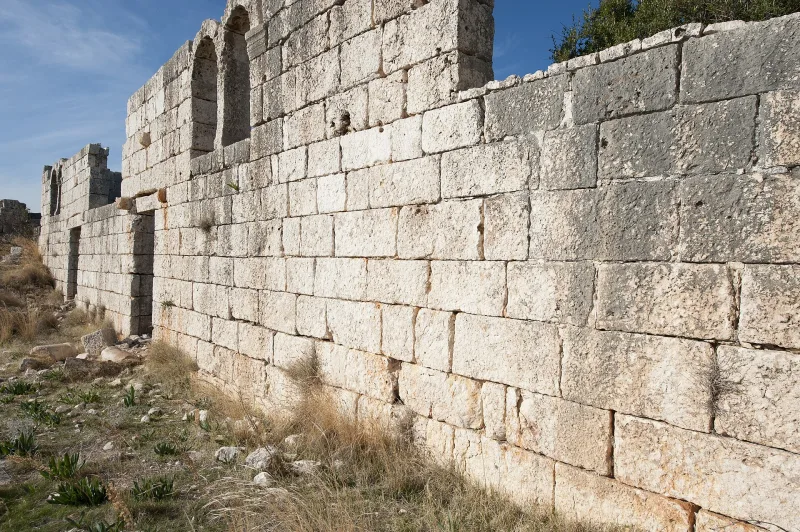
The coastal fortress on the mainland has a rectangular layout with double walls, square towers, and two chapels inside. The Byzantine foundation preserved the architectural plan, while Armenian builders added additional defensive elements. This is one of the best-preserved coastal fortresses in the Eastern Mediterranean.
Triumphal Arch and Necropolis
Outside the castle, along the road to the Corycian Cave, lies a vast Christian necropolis with dozens of sarcophagi and three early Christian churches. Among the tombs, the “beautiful Christian tomb” with a carved façade stands out—a fine example of late Roman funerary art.
Corycus Cave (Cennet ve Cehennem)
A few kilometers from Corycus lies the “Heaven and Hell” (Cennet ve Cehennem) sinkhole complex—two karst sinkholes, one of which, according to ancient legends, was home to the monster Typhon. At the bottom of the “Heaven” sinkhole, a 5th-century Armenian chapel has been preserved. Ancient Corycus was famous for growing saffron on the slopes surrounding the cave.
Interesting Facts and Legends
- According to a local legend about the Maiden’s Castle, a king imprisoned his daughter on the island because a soothsayer predicted her death from a snake bite. However, the snake made its way onto the island in a basket of fruit, and the princess perished. There is a similar legend about other “Maiden’s Towers” in Turkey—in Istanbul and Tarsus.
- The Armenian Kingdom of Cilicia held Corycus for over 150 years; both fortresses are the world’s best-preserved examples of Armenian military architecture outside of Armenia.
- Armenian inscriptions from the 13th–14th centuries, bearing the names of builders and dates of restorations, have been preserved on the walls of the seaside castle.
- Ancient Corycus was one of the world’s leading suppliers of saffron, grown around the Corycian Cave; saffron was highly valued in Roman and Byzantine medicine.
- In the 14th century, the island and fortress were purchased by the Cypriot King Peter I of Lusignan from the Armenian king—one of the final episodes of the Crusader presence in the Eastern Mediterranean.
How to get there
Corycus is located in the village of Kızkalesi in the Erdemli district of Mersin Province. GPS coordinates: 36°27′55″N 34°09′15″E. The nearest major airport is Adana (ADA), about 130 km along the D400 highway. An alternative is Hatay (HTY), 200 km away.
By car from Mersin, it is about a 60 km drive along the scenic coastal D400 highway (about 1 hour). Regular dolmuşes run from Erdemli and Mersin to Kızkalesi. The coastal castle stands right by the road, while the sea castle is 200 meters from the shore; you can swim there in the summer or hire a small boat from local fishermen (5–10 minutes).
It’s convenient to combine this visit with trips to Cennet ve Cehennem (3 km), ancient Elaiussa Sebaste (5 km), and Kanlıdivane (15 km)—you can spend a whole day exploring the Cilician antiquities along this stretch of coast.
Tips for travelers
The best seasons are April–June and September–October. It’s hot in Kızkalesi in the summer, but the beach near the castle is open, so you can combine sightseeing with swimming. It rains in the winter, but the castles themselves are accessible year-round.
Allow 3–4 hours: the coastal castle (1 hour), the ferry ride to the island (15 minutes), the sea castle (1–1.5 hours), and the necropolis (1 hour). Wear closed-toe shoes: there are many stones, and the fortresses have steps without railings.
Boats to the island run constantly from Kızkalesi Beach in the summer; the fare is inexpensive—negotiate with the boatman on the spot. An alternative in the summer is to swim across (200 meters of calm water, but there may be currents). There is no shade inside the sea castle—bring water and a hat.
For photographers: the sea castle at sunset from Kızkalesi Beach—the sun sets behind the fortress, creating a particularly dramatic silhouette. In the morning, it’s better to photograph the coastal castle and the necropolis—the lighting is frontal at that time.
The village has many seafood restaurants and cafes serving local Cilician cuisine; in the summer, cezerye (a carrot dessert) from nearby Mersin is especially good. After visiting the castles, be sure to stop by Cennet ve Cehennem: the descent into the “Paradise” crater and the ancient chapel at the bottom—an experience that perfectly complements the castles.