Karatepe — a Neo-Hittite city and the Rosetta Stone of Anatolia
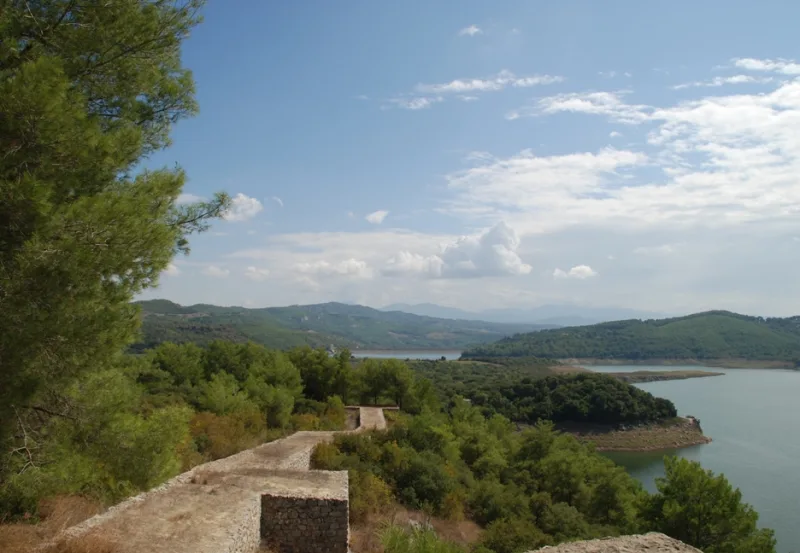
Karatepe is one of the most significant archaeological sites in southern Turkey, located on the right bank of the Ceyhan River in Osmaniye Province, approximately 23 kilometers from the district center of Kadirli. This fortified New Hittite city from the 8th century BCE became world-famous thanks to the bilingual Azatiwada inscription—a Phoenician-Luwian text that served as the “Rosetta Stone” for deciphering Hittite hieroglyphs. Today, Karatepe is an open-air museum within the Karatepe-Arslantaş National Park, where bas-reliefs, lion sculptures, and sphinxes remain in their original locations, and visitors literally walk through the same gates that Hittite warriors and merchants passed through three thousand years ago.
Karatepe is a must-see for anyone interested in the history of the Ancient East, epigraphy, and the culture of the post-Hittite kingdoms of Anatolia. It is a rare case where a major scientific discovery is still presented to visitors in the most authentic setting possible, without the artifacts having been moved to museums in the capital.
History and Origins
At the end of the 12th century BCE, the Hittite Empire—one of the great powers of the Bronze Age, which controlled most of Anatolia and Northern Syria—collapsed. From the ruins of this empire emerged the so-called Neo-Hittite states (or Syro-Hittite kingdoms)—small political entities that inherited the Hittite language, hieroglyphic writing, and cultural traditions. Karatepe emerged specifically as a border outpost of one such kingdom—Adanawa—located on the territory of the modern Çukurova Plain, with its center in the area of present-day Adana.
The Age of Azatiwata
The city gained its fame under the ruler Azativada (also Azatiwata) in the 8th–early 7th centuries BCE. According to Azativada’s own inscriptions, he was appointed ruler by “King Awarikus,” the ruler of Adanawa, and the city of Karatepe itself (its ancient name is unknown—possibly Azativadia, in honor of its founder) became his main stronghold. Azativada became famous for his military victories, territorial expansion, and a peaceful policy that protected civilians and merchants on the trade routes between Anatolia and Syria.
In the inscriptions, Azativada appears before us as a wise and merciful ruler: “I have filled the granaries of Adanava; I have set horse against horse, shield against shield, army against army, by the power of Baal and the gods; I have destroyed all the villains, and where men once feared to walk the road—now women walk with spindles.” This poetic formula is a model of ancient Near Eastern royal rhetoric and, at the same time, valuable evidence of the Neo-Hittite ruler’s social program.
The End of the City
The exact circumstances of Karatepe’s destruction are unknown. Archaeologists suggest that the city was destroyed in the late 7th century BCE during the Assyrian conquests, or later—during the Cimmerian invasion. After its destruction, the site was not rebuilt, and the ruins were gradually overgrown by forest and forgotten for 2,500 years, until 1946, when the German scholar Helmuth Theodor Bossert began systematic excavations there. A layer of burnt debris several dozen centimeters thick has been found almost everywhere—this is rare archaeological evidence of “fire destruction,” characteristic of Assyrian and Neo-Elamite conquests.
Discovery and Research
The excavations at Karatepe, which continued from 1946 to 1957 under the direction of Bossert and his Turkish colleague Halet Çambel, became one of the greatest scientific events of the 20th century. The main discovery was the “bilingual Karatepe”—an inscription carved in parallel in the Phoenician alphabet (well known to science) and hieroglyphic Luwian (at that time almost undeciphered). Comparing the texts allowed scientists to decipher the Hittite hieroglyphs—a task they had struggled with for decades. That is why Karatepe is often called the “Rosetta Stone of Anatolia.”
Further research continued in the 1980s and 1990s under the direction of Halet Çambel: the central part of the city and the royal palace were excavated, and large-scale work was carried out to conserve the stone, protect the orthostats from weathering, and create Turkey’s first open-air archaeological museum. Since then, Karatepe has become a benchmark for the museumification of Hittite heritage and a research hub for several generations of archaeologists and epigraphers.
Architecture and What to See
The city of Karatepe is situated atop a hill overlooking the Ceyhan Valley and is surrounded by a massive stone wall approximately 1.2 kilometers long, featuring two gates—the Northwest and Southeast gates. The walls are constructed of large, carefully fitted limestone blocks. Inside the walls were the royal palace, residential quarters, and utility buildings, some of which have been partially preserved as foundations.
Northwest Gate
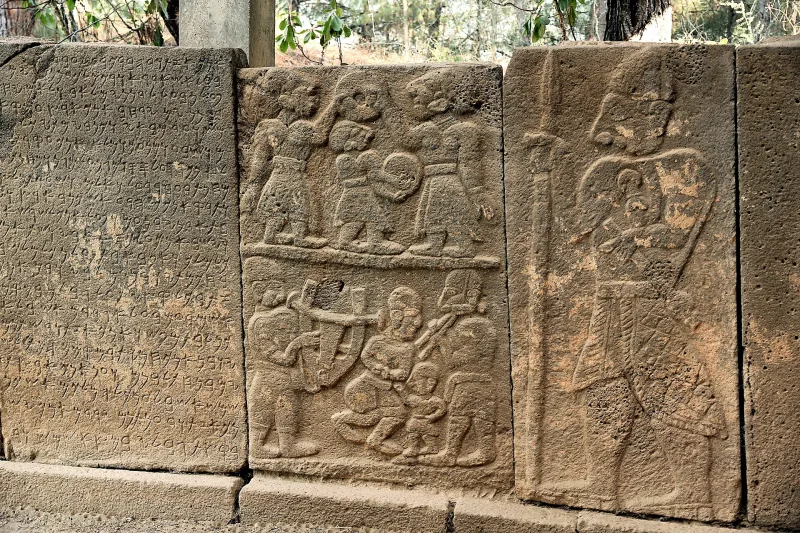
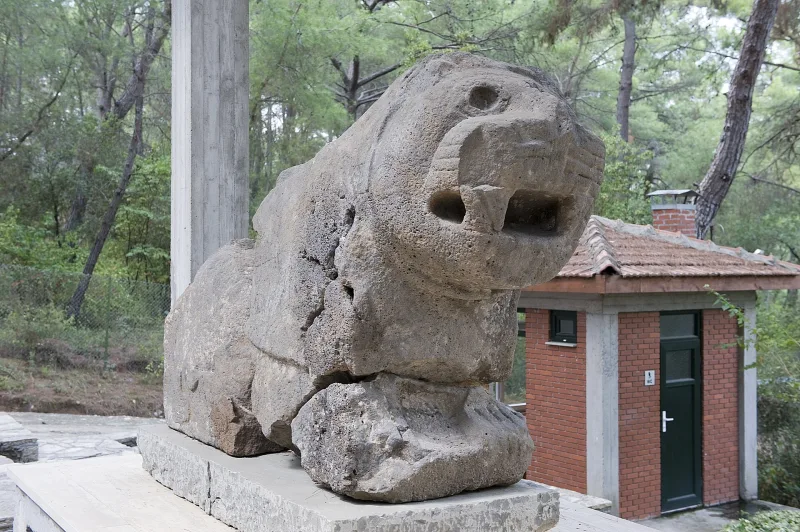
The city’s main ornamentation consists of stone orthostats (vertical slabs at the base of the walls) at both gates, covered with bas-reliefs. At the Northwest Gate, scenes of a royal banquet, a lion hunt, ships with rowers, musicians with lyres, and sacrificial scenes are particularly well-preserved. The style of the sculpture is typically Neo-Hittite: stocky figures in long robes, expressive faces, and a keen attention to detail in clothing and weapons. Statues of lions and sphinxes stand near the gates as guardians—hence the site’s second name, “Aslantas,” meaning “lion stone.”
Southeast Gate
At the Southeast Gate are the most famous orthostats—those bearing Azativada’s bilingual inscription. The text begins with the words: “I am Azativada, blessed by Baal, servant of the God of Thunder, whom Avaricus, king of Adanava, made great...” — and continues with a long account of the ruler’s deeds, his construction projects, and curses against those who dare to destroy the city. The Phoenician and Luwian versions of the text are nearly identical, which allowed them to be compared.
Sculptures and Their Preservation
All stone slabs, statues, and stelae have been left in their original locations on the site, turning Karatepe into a true open-air archaeological museum—the first of its kind in Turkey. To protect the reliefs from weathering and precipitation, canopies and glass pavilions have been erected over particularly valuable sections. Copies have been placed next to some artifacts: the originals are kept in protected display cases, while the replicas allow visitors to touch the stone and take photos without a flash.
The Palace and Residential Area
In the city center, archaeologists discovered the remains of the Azativada Palace with its characteristic “bit-hilani”—a grand entrance design typical of Neo-Hittite and Northern Syrian architecture, featuring two columns and a wide porch. The palace had several rooms with hewn-stone masonry and was decorated with orthostats depicting palace scenes. The city’s residential area, occupying most of the enclosed space, consists of the foundations of houses belonging to ordinary citizens and artisans, as well as utility structures—granaries, water cisterns, and grain pits.
Interesting Facts and Legends
- The bilingual inscription at Karatepe is considered one of the largest and most complete inscriptions in the Phoenician language in the entire Eastern Mediterranean—its scientific significance is compared to Champollion’s Rosetta Stone.
- Helmut Bossert literally walked across the entire Eastern Mediterranean in search of the “mountain with lion stones” promised by local peasants—and that is how he discovered Karatepe.
- Archaeologist Halet Çambel, who worked at Karatepe for several decades, is considered one of the pioneers of women’s archaeology in Turkey.
- The city was called Azatiwadiya in honor of its ruler Azatiwada—one of the few Neo-Hittite settlements whose ancient name is reliably known thanks to its own inscriptions.
- The reliefs at Karatepe depict not only local motifs but also Assyrian, Phoenician, and Egyptian influences—this is one of the best visual testimonies to the cultural dialogue of the Eastern Mediterranean in the 8th century BCE.
- Among the unique scenes on the orthostats is a depiction of an ancient ship with rowers—one of the rarest surviving visual accounts of the New Hittite naval fleet.
- The lion sculptures of Karatepe are among the most expressive in Anatolian Iron Age stone sculpture; their characteristic muzzle with a slightly open mouth and accentuated mane became the canonical image of New Hittite “royal beast” iconography.
- The Azativada text includes detailed curses for anyone who dares to damage the monument: “May Baal and all the gods of the city destroy his kingdom and his descendants.” To this day, the stone remains relatively intact—which, however, is due not to ancient curses but to the meticulous work of restorers.
How to get there
Karatepe is located in Karatepe-Aslantaş National Park (Karatepe-Aslantaş Millî Parkı), in the Kadirli district of Osmaniye Province. The nearest airport is Adana Şakirpaşa (ADA), about 125 km away; the drive takes 1.5–2 hours. From Adana, take Highway O-52 / D-825 toward Kadirli, then follow the local road to the Aslantaş Dam; from the national park entrance to the museum itself, it’s another 3 kilometers of paved road through a pine forest.
It is about 35 kilometers from Osmaniye to the park. There is no public transportation directly to Karatepe—it is best to take a taxi or rent a car. From Istanbul, Ankara, and other major cities, the most convenient option is to fly to Adana. The park has parking, restrooms, and beverage kiosks. A separate ticket is required at the museum entrance—exact prices and hours may vary, so it’s best to check in advance.
Tips for travelers
The best time to visit Karatepe is in the spring (April–May) and fall (September–November). In summer, it gets very hot (up to 38°C) and humid in Çukurova, especially around noon; in winter, rain and mud are possible. The museum is usually open from 9::00 to 5::00 (in winter, until 4::30), but hours may vary on religious holidays.
Allow 2–3 hours to explore the town and the open-air museum. Wear comfortable shoes (the trail climbs rocky slopes in some places), a hat, and bring water, a snack, and sunscreen. For photography, it’s best to visit in the morning or evening—the soft light highlights the relief of the orthostats. Flash photography is prohibited in the pavilions; tripods are also usually not allowed to avoid holding up the flow of visitors. There are no detailed Russian-language audio guides on site—it’s worth downloading materials in advance or hiring a local guide (it’s best to arrange this from Adana or Kadirli).
Karatepe pairs well with other regional sites: Hierapolis-Castabala, the Adana Fortress (Adana Kalesi), the Adana Archaeological Museum, and the Toprakkale Fortress. Together, they form a rich itinerary titled “From the Hittites to the Ottomans,” which takes 2–3 days. For an overnight stay, Adana is the most convenient choice—it offers a wide selection of hotels in all categories, excellent cuisine, and well-developed infrastructure. In a day and a half to two days in the Osmaniye region, you can trace the entire chronology of local history—from the Hittites to the Ottomans. For a deeper immersion, I recommend reading the translation of the Azativada inscription and a general overview of the Neo-Hittite kingdoms before your trip—this will greatly enhance your experience of the visit. Karatepe rightfully holds one of the top spots on the list of anyone who wants to understand ancient Anatolia.