Alaçatı—stone-paved streets, the breeze, and the wine of the Aegean coast
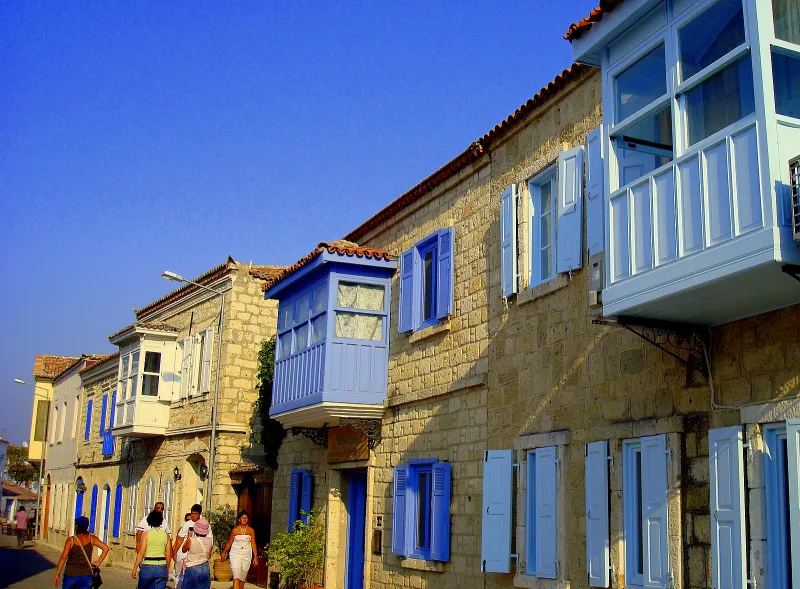
Alaçatı is perhaps the most photogenic spot on the Çeşme Peninsula in the province of Izmir. It is here that the Meltem wind sweeps through the narrow streets, ruffling the curtains of boutique hotels, while stone Greek houses with lavender and sky-blue shutters line the pavement as if someone had deliberately set up a film set. Today, Alaçatı is a small settlement with 10,386 residents (2022 census), but it is this very village that has become a symbol of the reimagined Aegean: a place where Ottoman mansions have been converted into wine bars, where women gather wild herbs for the April festival, and where the world’s best windsurfers catch the steady southerly breeze in Agrilia Bay. This guidebook covers history, architecture, legends, and practical tips to ensure your trip to Alacati isn’t just another “tourist checkpoint,” but a true immersion in the culture of the Aegean coast.
The History and Origins of Alacati
The history of Alacati is a history of constantly changing names and peoples. In antiquity, the bay adjacent to the present-day village was called Agrilia (Αγριλιά)—“wild olive”: it was an important port through which Izmir exported its olive oil until World War II. Ottoman tax registers from 1525 already record the neighboring settlement under the Turkish name Alacat or Alacaat, derived from “alaca at”—“spotted horse.”
There are several versions regarding the origin of the name. According to one, the name comes from the Greek αλάτι (“salt”): sea salt was mined on the peninsula for centuries, and even during the Ottoman era there was a special tax called “alatsatikos” levied on saltworks. According to another legend, a local ruler rode a piebald horse, and passersby nicknamed him “Alacaatlı”—“the man with the piebald horse”; over time, the name stuck to the village itself. The third, most poetic version explains the name as “Ala çatı”—“shimmering roof”: strong winds would lift laundry left out to dry and carry it onto neighboring roofs, painting them with bright splashes of color.
The modern village took shape in the 17th century, when the local agha, Haji Memish Agha, invited Greek settlers from the island of Chios and the surrounding islands to drain the coastal marshes. By 1895, of the 13,845 residents, only 132 were Muslims—the rest of the population consisted of Greeks, whom the locals called “Alatsatians.” In 1904, the census recorded about 15,000 residents, and Alatsata (as it was called then) was a thriving center of winemaking.
The twentieth century dealt a cruel blow to the village. According to the Smyrna Supreme Commission, in May 1914, 14,000 Greeks were forcibly expelled from Alatsata. After the Balkan Wars, they were replaced by Muslim refugees from Kosovo, Albania, and Greek Macedonia. Following Greece’s defeat in the Greco-Turkish War and the signing of the Treaty of Lausanne in 1923, a final population exchange took place: Muslims from Crete, Thrace, Macedonia, and the Dodecanese Islands moved into the abandoned stone houses. Since 1928, the village has borne its current name—Alaçatı.
Architecture and What to See
In 2005, Alaçatı was designated a protected historic zone, and this is precisely what saved the village from being overrun by generic concrete box buildings. Several hundred 19th-century Ottoman-Greek stone houses have been preserved here, and new construction is required to mimic traditional styles. A walk through the center takes anywhere from two hours to a full day—depending on how often you stop to sit in the courtyard cafes.
Kemalpaşa and Hacımeş—the main streets
Two parallel streets, Kemalpaşa Caddesi and Hacı Memiş Caddesi, form the heart of the village. This is where the boutiques, wine bars, antique shops, and restaurants that have set up tables right on the cobblestones are concentrated. In the evenings, the streets fill with Istanbul’s bohemian crowd, Italian photographers, and local families, turning the traffic into a slow-moving carnival.
Stone houses with "cumbas"
A distinctive feature of the houses that belonged to Ottoman Greeks is the enclosed bay window, known in Turkish as a “cumba.” It juts out over the street, usually with three windows, and is almost always painted in pastel lilac or pale blue. The first floor is clad in rough-hewn sandstone, the second is plastered, and the shutters and doors provide the village’s signature color palette. The contrast of white walls, bright details, and purple bougainvilleas is the main visual motif of all Alacati postcards.
Windmills (Yel Değirmenleri)
Several white stone windmills from the 19th century stand on a hill above the village. Some have been restored, while others are striking ruins. In the past, they ground grain brought in by sea, but today they serve as the best viewing platform: from here, you can see all of Alaçatı, the marina, and the rugged coastline of the Çeşme Peninsula.
Alaçatı Port and Marina
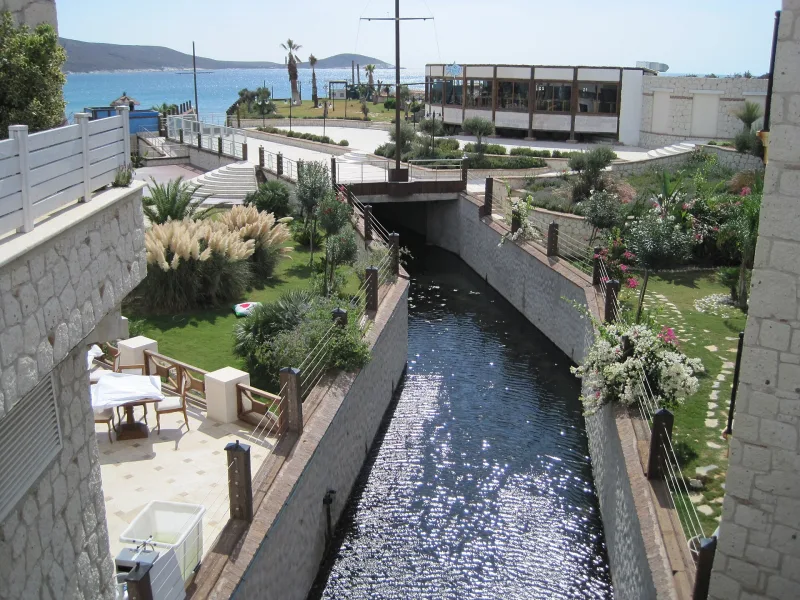
A few kilometers from the historic center, in the former Agrilia Bay, lies the Port Alaçatı marina, designed by French architect François Spoerri and his son Yves Spoerri—the very same architects who created Port Grimaud on the French Riviera. The result is instantly recognizable: white townhouses, canals, yacht parking, and the feel of a “Mediterranean town built from scratch.” Yachts from all over the Aegean come here, and restaurants with views of the harbor are opening up.
Windsurfing Bay
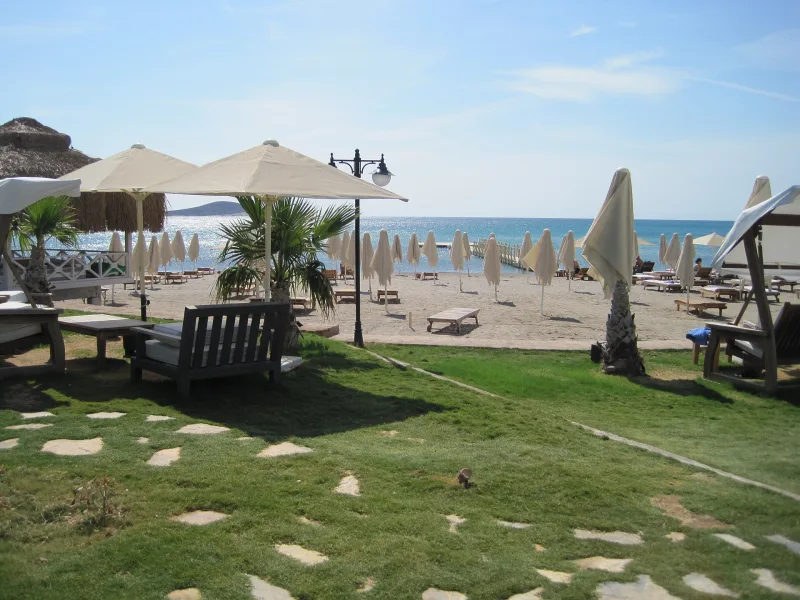
That same bay, with its shallow, flat bottom, has turned Alacati into one of the world’s best windsurfing resorts. The wind blows 330 days a year, the southerly breeze provides waves for freestyle, and the shallow water makes the spot safe for beginners. PWA professionals call Alacati the “slalom capital of the world,” and a stage of the world tour is held here every year. Schools offer equipment for windsurfing, kiteboarding, canoeing, and SUP.
Interesting Facts and Legends
- In 2010, The New York Times ranked Alacati 8th on its list of must-visit places that year—after which the influx of tourists from Europe and Asia grew exponentially.
- In 2004, Japanese TV presenter Nana Eikura filmed a documentary about the village, and since then Alaçatı has been popular with Japanese and Korean travelers—a rarity for small Aegean towns.
- Every April, Alaçatı hosts the Alaçatı Ot Festivali: locals gather dozens of varieties of wild Aegean greens, and chefs compete in dishes made from natural ingredients and “forgotten recipes.”
- Since 2017, the Kaybolan Lezzetler Festivali—the “Festival of Disappearing Flavors”—has also been held here, dedicated to preserving ancient recipes that are gradually fading from family kitchens.
- After traveling through the region, writer Mehmet Julum wrote the novel “Alaçatılı”—about the intertwining fates of Greeks and Turks in these stone houses; for Turkish readers, it is a sort of local “Quiet Odessa.”
- In the town of Somerville, not far from Boston, there is still a neighborhood called Small Alatsata, founded by refugees from Alaçatı in the early 20th century—a rare instance where an Aegean village gave rise to a diaspora “new settlement” in the United States.
How to get there
Alacati is located 76 km from the center of Izmir and just 8.6 km from the town of Çeşme. The nearest airport is Izmir Adnan Menderes (ADB), which has direct flights from Istanbul, Ankara, and many European capitals. The distance from the airport to Alacati is about 85 km, or a 1-hour drive on the O-32 Izmir-Cesme expressway.
The most convenient option is to rent a car right at the airport: distances on the Çeşme Peninsula are short, and a car will allow you to visit Çeşme, Yalıçık, and the wild beaches. If you don’t have a car, there are two public transport options: buses operated by Kamil Koç and other carriers from Istanbul’s Otogar bus station to Çeşme (a 10–12-hour overnight trip), or the “flight to Izmir + bus” combination. Direct buses run every 30–40 minutes from the ÜÇKUYULAR bus station in Izmir to Çeşme; the trip takes about 1 hour and 15 minutes, and tickets are inexpensive. Dolmuşes run every 15–20 minutes from the Çeşme bus station to Alaçatı; the trip takes less than 10 minutes.
Vehicle access to Alacati’s historic center is partially restricted—leave your car at one of the paid parking lots on the outskirts and explore the labyrinth of narrow streets on foot.
Tips for travelers
The best time to visit is from late April through June and from September through mid-October. In spring, the April Herb Festival is in full bloom and the town isn’t yet overcrowded; in fall, the sea water remains warm, and the crowds thin out. July–August is peak season: hotel prices triple, and the cobblestone streets are packed in the evenings. Winter is a time for quiet cafes, wind, and rain, when the village belongs to the locals.
Be sure to book your hotel in advance: there are practically no large hotels in Alacati, only boutique properties in those very stone mansions, and during the season they sell out a month in advance. When choosing a room, pay attention to the location—staying right in the center is romantic, but it’s noisy until late at night because of the bars. Quieter options are on the outskirts of the historic district.
Be sure to try the local cuisine: kumquat jam for breakfast, salads made with Aegean herbs (ot kavurması), seafood in tiny restaurants by the marina, and desserts made with mastic from the mastic tree (Pistacia lentiscus), which has been being replanted on the Çeşme Peninsula since 2008 as part of a TEMA Foundation project—by 2011, more than 3,000 saplings had been planted. Mastic ice cream, mastic coffee, and mastic powder are the peninsula’s calling cards.
For windsurfers, the best month is July, when the wind is steady; beginners are better off visiting in May and September, when the wind is gentler. Combine your trip with a visit to Çeşme (the 14th-century Genoese fortress and the Yalıcı thermal springs), as well as the villages of Ildırı and Şirince. If you’re looking for solitude, rent a car and head to the peninsula’s northern coast, to the wild bays of Altinkum and Ciftlikkoy. Alacati is beautiful not only for its picture-perfect streets, but also because a ten-minute drive takes you to a completely different landscape—amidst vineyards, olive groves, and the open Aegean Sea. It is precisely this opportunity to combine the rhythm of a trendy village with the tranquility of the real Aegean that makes it one of the best destinations on the Turkish coast.