Hierapolis—an ancient sacred city overlooking the travertines of Pamukkale
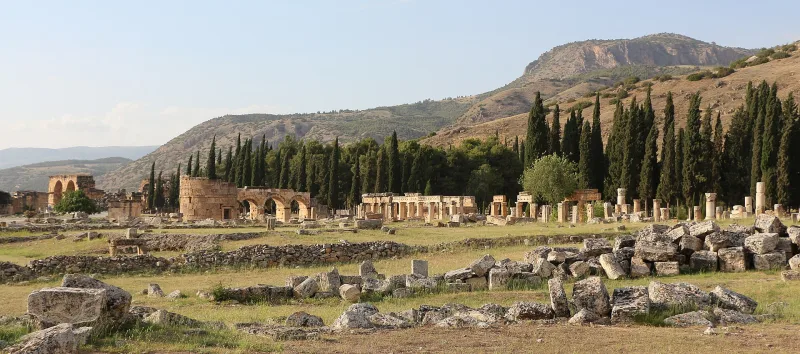
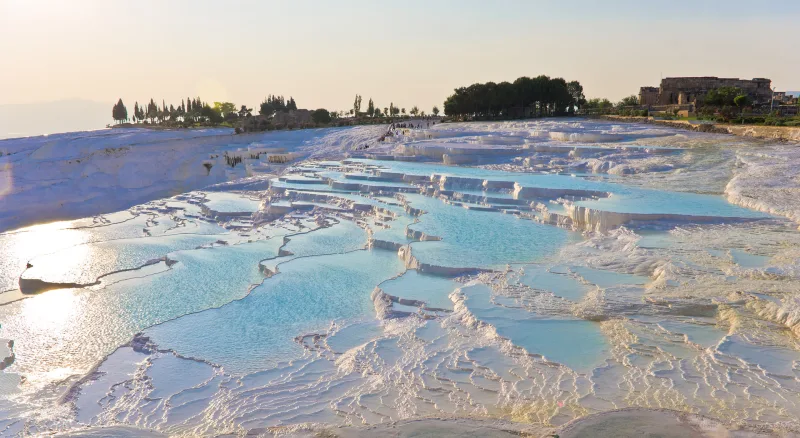
Ancient Hierapolis is one of Turkey’s most remarkable archaeological sites, situated atop the famous snow-white travertines of Pamukkale in the province of Denizli. This city, whose name translates from Greek as “sacred city,” was simultaneously a center of healing, an important crossroads on trade routes, and a place of worship for several deities. In 1988, Hierapolis, along with the natural terraces of Pamukkale, was inscribed on the UNESCO World Heritage List as a mixed cultural and natural site—one of only two such sites in Turkey. Today, millions of travelers come here every year to stroll through the ruins of the ancient city, bathe in the thermal waters of “Cleopatra’s Pool” among submerged ancient columns, and see one of the largest necropolises of the ancient world.
History and Origins of Hierapolis
Hierapolis was founded in the late 2nd century BCE, presumably by Eumenes II, king of Pergamon, who recognized the strategic and economic potential of the site with its hot springs, fertile lands, and rich mineral resources. The thermal waters themselves were revered long before the city’s founding—the local Phrygians worshipped the “Great Mother” Cybele and believed that the steam rising from underground crevices was the breath of an underground god. It was this unique feature of the landscape that determined the city’s sacred status.
In 133 BCE, following the will of Attalus III, Hierapolis, along with the entire Kingdom of Pergamon, came under the rule of the Roman Republic. The Roman period marked a golden age: after the devastating earthquake of 60 CE, Emperor Nero allocated funds for the city’s reconstruction, and during the 2nd–3rd centuries under the Antonines and Severans, Hierapolis reached the peak of its wealth and population (up to 100,000 people). The city became known as a center for medical tourism—the sick came here from all over the Mediterranean to take thermal baths and pray to the gods. According to Christian tradition, the Apostle Philip was crucified and tortured here in 80 CE.
During the Byzantine era, Hierapolis became an important ecclesiastical center and the seat of a metropolitan bishop. An earthquake in 1354 destroyed most of the buildings, and the city was finally abandoned. Modern excavations have been conducted since 1957 by an Italian archaeological mission, which has managed to restore many monuments and transform Hierapolis into one of the country’s most visited archaeological parks.
Architecture and What to See in Hierapolis
The archaeological site stretches over 3 km along the plateau, so you should plan on spending half a day for a thorough tour. It’s best to start at the northern entrance, near the necropolis.
Roman Theater
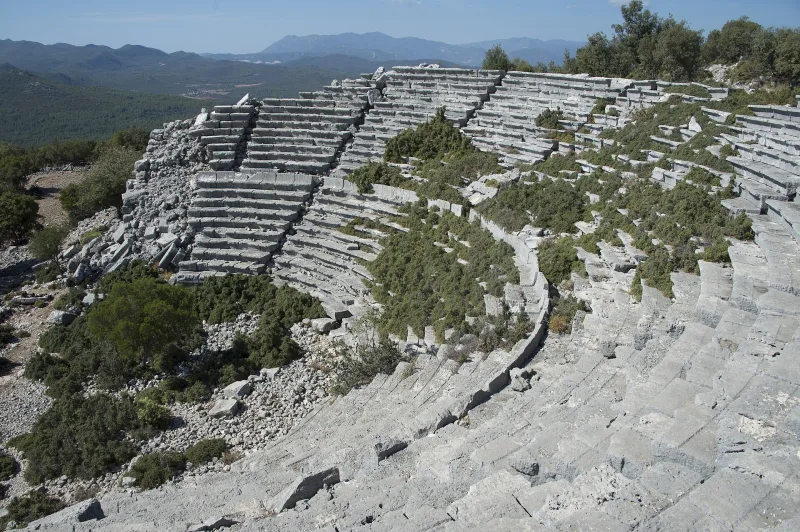
The main architectural gem is the Roman theater from the 2nd–3rd centuries CE, one of the best-preserved in Turkey. It seated about 12,000 spectators, and its stage (skene) is decorated with marble reliefs depicting Dionysus, Apollo, and Artemis. Following a major restoration in 2013, the theater has regained its ancient appearance and is occasionally used for concerts.
Cleopatra’s Pool and Thermal Baths
A unique attraction is Cleopatra’s Pool, or the Ancient Pool, where visitors can bathe in healing thermal water (+36°C) amidst submerged Roman columns and capitals that fell during earthquakes. According to legend, this pool was a gift to Cleopatra from Mark Antony. There is an admission fee, but the experience of swimming among archaeological artifacts is truly unique.
Martyrium of the Apostle Philip and the Temple Complex
In the eastern part of the city, on a hill, stand the ruins of an octagonal martyrium built in the 5th century over the supposed tomb of the Apostle Philip. Nearby, in 2011, the apostle’s actual tomb was discovered—one of the most sensational archaeological finds of the 21st century. Not far away, traces of the Temple of Apollo and the famous Plutonium—the entrance to “Pluto’s Cave,” from which poisonous volcanic gases emerge—have been preserved. Ancient priests demonstrated a “miracle” by leading animals into the cave, which instantly fell dead, while the castrated priests of Cybele were immune to the gas thanks to a special breathing technique.
Northern Necropolis
One of the largest ancient necropolises in Asia Minor, it contains over 1,200 tombs, crypts, and sarcophagi from the Hellenistic, Roman, and early Christian periods. Pilgrims and the sick from all over the ancient world are buried here, and due to the variety of burial types, this place is a veritable encyclopedia of ancient funeral traditions.
Hierapolis Archaeological Museum
The museum is located in a 2nd-century AD ancient bathhouse and houses a collection of sculptures, sarcophagi, and reliefs from Hierapolis itself and from Aphrodisias—combining a visit to both is particularly convenient.
Frontinus Street and the City Gates
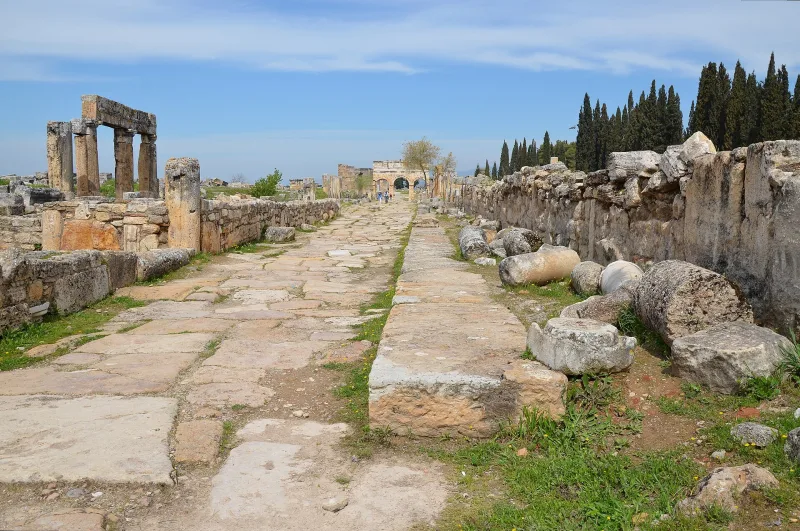
The main axis of the ancient city is Frontinus Street, named after the Roman proconsul Sextus Julius Frontinus, who financed its paving in the late 1st century CE. The street stretched from north to south for nearly 1,200 meters and was adorned with porticoes, benches, and small shrines. On either side of it, latrines have been preserved—public toilets with 24 stalls, marble seats, and running water, among the best-preserved in Asia Minor. At the northern end of the street stands the three-arched Arch of Domitian (Frontinus), built in 84–86 CE—the main entrance to the city, through which pilgrims and merchants from all over the Mediterranean passed.
Byzantine Basilica and Cathedral
Christian Hierapolis left just as significant a mark as the pagan one. The ruins of the monumental five-aisled basilica from the 5th century CE are located in the central part of the city and, despite the destruction, are impressive in size. Nearby, the foundations of a 6th-century cathedral have been preserved, built on the site of an earlier temple of Apollo. In the side aisles, archaeologists found fragments of a marble altar screen featuring Christian symbols—crosses, fish, and grapevines. It was in these very basilicas that regional church councils were held in the 5th–7th centuries, one of which addressed issues of Monophysitism.
The Gorgon Pediment and the Sculptural Program
In the Roman theater of Hierapolis, the sculptural decoration of the skene deserves special attention: scenes depicting the birth of Apollo on Delos, the battle of the Amazons, the triumph of Dionysus, and a procession in honor of the goddess Artemis of Ephesus. The central feature is the pediment with the Gorgon Medusa—one of the most expressive reliefs of late 2nd-century CE Asia Minor sculpture. Many original fragments are now housed in the Hierapolis Archaeological Museum, while exact replicas have been installed in their original locations.
Interesting Facts and Legends
- The travertine terraces of Pamukkale formed over hundreds of thousands of years due to the precipitation of calcium carbonate from thermal waters. The snow-white terraces grow by approximately 1 mm per year, and their total length is about 2.7 km.
- In 2013, Italian archaeologists announced the discovery of Plutonium—the “gateway to hell.” Measurements revealed a high concentration of carbon dioxide at the entrance, scientifically confirming ancient accounts of “deadly fumes.”
- The tomb of the Apostle Philip was found not inside the martyrium but in a neighboring temple building, which caused a sensation in Christian archaeology.
- Hierapolis was one of the first resort towns in human history—lists have survived of prominent Romans who came here specifically to treat gout, rheumatism, and skin diseases.
- After the 1354 earthquake, Hierapolis was abandoned, but local farmers continued to use the travertine terraces to raise carp in natural ponds, which helped preserve the terraces to some extent.
- An Italian archaeological mission led by Paolo Verzoni, which began work here in 1957, used the method of anastylosis—returning fallen columns and blocks to their original places—which was innovative for its time. This method later became the standard for excavations at Sagalassos and Aphrodisias.
- According to legend, pilgrims who came to Hierapolis seeking healing left bronze plaques with requests to the gods in the sacred springs. Archaeologists have found hundreds of them—in Greek, Latin, and sometimes in Aramaic and Coptic—confirming the resort’s international status in antiquity.
Hierapolis in Ancient Literature
Many ancient authors wrote about the healing properties of Hierapolis’ waters. Strabo, in his *Geography* (XIII, 4), describes Plutonium and its poisonous vapors in detail; Pliny the Elder, in his *Natural History*, mentions the local travertine as an ideal material for making statues; Vitruvius praises the engineering solutions of the city’s aqueducts. In late antiquity, Hierapolis was celebrated by the Christian poet Gregory the Theologian, who was treated here for gout. The city is even mentioned in the “Acts of Paul and Thecla”—an apocryphal text recounting the stories of early Christian preachers in Asia Minor.
How to get to Hierapolis
Hierapolis and Pamukkale are located 20 km from the city of Denizli. The easiest way to get there is by bus from Denizli: dolmuşes depart from the bus station every 20–30 minutes, and the journey takes about 40 minutes. Denizli is connected by direct buses to Izmir (4 hours), Antalya (4 hours), Istanbul (10 hours), and Cappadocia (about 9 hours). There is also a small airport, Denizli Çardak, with daily flights from Istanbul.
Hierapolis-Pamukkale has two entrances: the northern and southern ones. The northern entrance is convenient for those who want to start their tour at the necropolis and walk down the travertine terraces; the southern entrance provides quick access to Cleopatra’s Pool and the theater. Many tourists come on a day trip from coastal resorts (Marmaris, Bodrum, Antalya), but one day is only enough for a superficial visit. It’s best to stay overnight in the village of Pamukkale to see the travertines at dawn, when there are no crowds.
Tips for travelers
The best time to visit is spring (April–May) and fall (September–October). In summer, the travertine pools with their warm water are pleasant, but the ruins get scorching hot under the sun. In winter, mornings can be chilly, but the scenery is particularly stunning. Plan for at least 5–6 hours: 2 hours for a walk through the travertines, 2 hours for the archaeological zone, an hour for Cleopatra’s Pool, and an hour for the museum.
Important rules: You may only enter the travertines barefoot to avoid damaging the fragile calcium terraces. Bring a towel, a change of clothes, beach slippers for changing, and a swimsuit if you plan to swim in the pool. You can carry your shoes in your hands or leave them in lockers. It’s recommended to bring water and a snack—there’s a café inside the complex, but prices are high.
Photographers should arrive at sunset: during the “golden hour,” the white terraces take on a soft pink and golden hue, and the view of the Lycos Valley from the top of the plateau is one of the most impressive in Turkey. A visit to Hierapolis and Pamukkale is often combined with a trip to Aphrodisias—these two UNESCO sites are relatively close and fit seamlessly into a single itinerary, revealing different facets of the ancient civilization of Asia Minor.
The best photo spots in Hierapolis include not only the travertines but also the view of the valley from the upper seats of the theater, the theater’s stage bathed in the warm rays of the setting sun, the Arch of Domitian against the backdrop of the necropolis, and, of course, Cleopatra’s Pool from above, where ancient columns are visible in the clear turquoise water. To photograph the museum’s finest frescoes and statues indoors, set your camera to high ISO—the lighting there is dim. When planning your route within the complex, keep the terrain in mind: it’s about 3 km from the north entrance to the south, with a significant elevation change; most visitors walk the entire way, but if you prefer, you can take the electric shuttle that runs between the entrances.
Gastronomically, Pamukkale is not a culinary wasteland, as it might seem. In the nearby village of Karaağaç, there are small family-run restaurants serving signature dishes of Denizli Province: “tandoor kebab” made from lamb baked in a clay oven, the famous “Denizli tavuğu”—roasted chicken served with a side of rice and local herbs—and a dessert of figs with walnuts, which has been prepared in this region for centuries. It is here that travelers discover that southwestern Turkey is not just about ruins, but also a vibrant culinary tradition rooted in antiquity. After a full day in the dust and under the sun, a simple dinner at a village tavern becomes part of the experience of visiting Hierapolis and Pamukkale, one that will remain in your memory no less than the snow-white terraces.
Finally, for those who love the unusual, it’s worth visiting a little-known corner of the complex—the Martyrdom of Philip with its octagonal structure. Archaeologists believe that in the 5th century, mass pilgrimages took place around it, and pilgrims left votive offerings in the niches in the walls. These niches have survived to this day, and thanks to the silence and seclusion of the place, you can really feel the atmosphere of the early Christian East here.