Antiphellus—a Lycian city with an amphitheater by the sea in the heart of Kaş
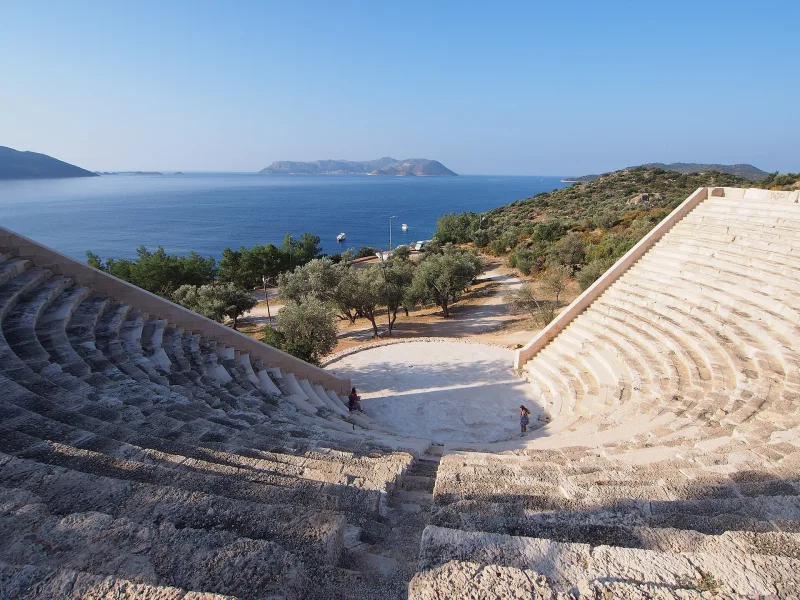
In the center of modern Kaş—one of the most charming resort towns in Turkish Lycia—a Hellenistic amphitheater suddenly rises above the rooftops: rows of white marble seats, open toward the sea, without a stone stage that would block the view of the endless blue water. This is Antiphellos, an ancient port city whose name, translated from Greek, means “land opposite the rocks.” Antiphellos minted its own coins, served as the arbitration center for the Lycian League, and survived the earthquake of 141 AD, rebuilding with funds from the renowned philanthropist Ophramoas of Rhodiopolis. Today, its ruins are so seamlessly woven into the living fabric of Kasha that one must deliberately slow down to distinguish the Lycian tombstones among the whitewashed houses.
History and Origin of Antiphellus
The city’s original Lycian name was Habesos; according to Pliny the Elder, it was pronounced Habessus prior to Greek colonization. Architectural fragments, now housed in the Antalya Museum, confirm the presence of the Lycians here as early as the 6th century BCE—which means that the neighboring mountainous Phellus was also inhabited at the same time. In the mid-6th century BCE, the region was conquered by the Persians and remained under their control until the arrival of Alexander.
During the Hellenistic period, Antiphellus became the port for Phellus—a small inland city located in the mountains. The name “Antiphellus” itself appears on a 4th-century BCE inscription found in Kas: it refers to the deceased as “a native of Antiphellus.” When Phellus began to decline, Antiphellus took over its functions and became the region’s largest center, gaining the right to its own mint.
In the Lycian League, the city held one vote—a modest but real political influence. Strabo mistakenly placed it among the inland cities (“In the interior of the country lie Fellus, Antifellus, and Chimera…”), which puzzled later geographers: in reality, the city stood on the shore of a bay, in the most vulnerable coastal position. It was from here, according to Pliny, that the world’s softest sponges were transported.
In 141–142, a catastrophic earthquake devastated the Lycian coast and, in all likelihood, triggered a tsunami that swept far inland. Antiphellus suffered serious damage: it was then that the eastern wall of the amphitheater collapsed, traces of its repair still clearly visible to this day. Funds for the restoration came from Opraomos of Rhodiopolis—a noble citizen who donated money to many of the affected cities of Lycia.
Irish naval officer Sir Francis Beaufort visited the site in the 1820s, when it was nearly uninhabited. In April 1840, English archaeologist and traveler Charles Fellows counted more than 100 stone tombs here. On his next visit, Fellows noted with regret that the settlement had expanded and engulfed many of the ruins: local residents were dismantling the flat slabs of the sarcophagi for building materials. By our time, most of the tombs have disappeared.
Architecture and What to See
The main feature of Antiphellus is how it coexists with the living city. Kaş has grown right on top of the Lycian ruins, and today you’ll find the monuments not within a fenced-off museum perimeter, but among cafes, hotels, and gardens.
Hellenistic Amphitheater
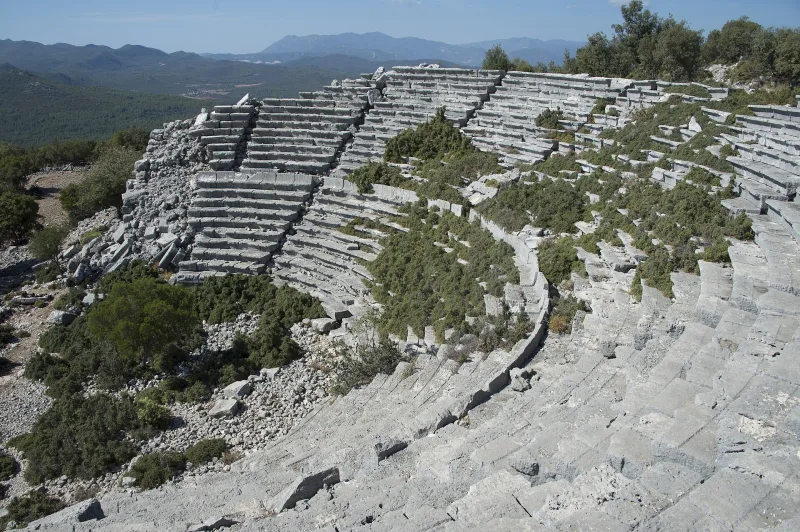
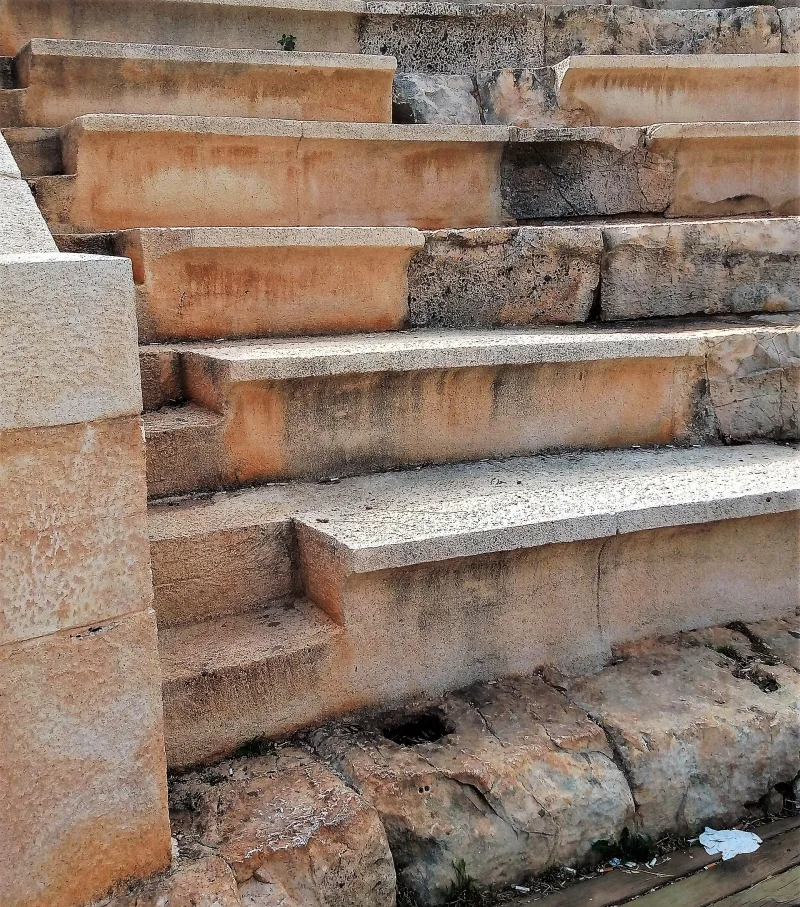
The amphitheater, located 500 meters from the center of Kaş, is the site’s undisputed gem. Built to seat 4,000 spectators, it is the only structure of its kind in Anatolia with a view of the sea: the architects deliberately omitted a stone stage (proskenion) so as not to obstruct the ocean panorama. The walls are constructed of irregularly shaped hewn stone, varying in form and size; there is no diazoma (the horizontal passageway dividing the sections). Following its 2008 restoration, the amphitheater is well-preserved. The eastern wall was destroyed, presumably by the earthquake of 141; the repairs are visible to the naked eye.
The King’s Tomb and an inscription in the Milian language
On Uzuncharshy Street stands a 4th-century BCE sarcophagus, known by the popular name “King’s Tomb.” The hyposorium (lower chamber), about 1.5 meters high, is carved directly into the bedrock; the floor is sunken, and the entrance is open. The hyposorium bears an epitaph of exceptional character—a poem written in the Mili language (Lycian B), an ancient Anatolian dialect attested in only three inscriptions: two poems on the Xanthus Obelisk and this short inscription. The text has not yet been fully deciphered. Charles Fellows noted in the 1840s that the inscription “does not begin in the manner of all those known to us and does not contain words of a funerary nature.” The first image of the tomb appeared as early as Luigi Mayer’s book *Views in the Ottoman Empire* (London, 1803). The sarcophagus is crowned by a lid with four relief panels featuring standing figures; on the front pediment are a bearded man with a staff and a seated woman—presumably the tomb’s builder and his wife.
Doric Tomb Above the Amphitheater
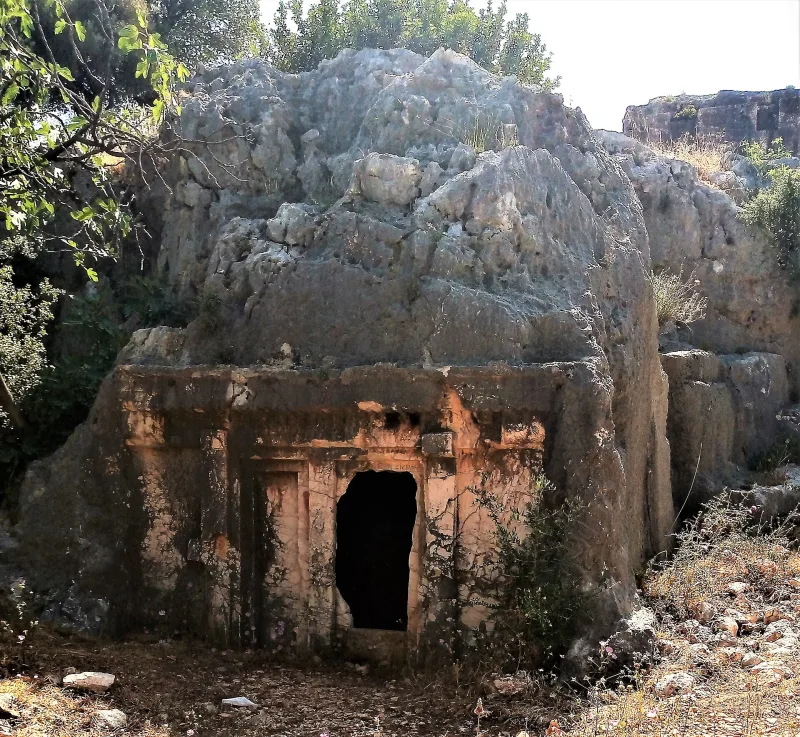
Just above the amphitheater, a Doric tomb has been carved into the rock—a cube with sides measuring 4.5 meters. The 1.9-meter-high entrance leads to a single chamber. On the interior wall, a relief depicting dancing girls has been preserved, covered in years of soot from the fires of shepherds who used the tomb as a shelter. Based on the dancers’ clothing, experts date the work to the first half of the 4th century BCE. On the exterior, a fluted base and corner pilasters are visible; one of the capitals has survived.
Small Temple, Rock-Cut Tombs, and Wall
A few steps from the center, the lower blocks of a small temple, five courses high and built of hewn stone, have survived. It was built in the 1st century BCE; its purpose and dedication are unknown—the cult has not been identified. Rock-cut tombs are hidden in the cliffs above the modern city: one of them contains both a Lycian inscription and a later Latin one. Stretching 460 meters west of the city is a coastal wall of six courses of dressed stone—the only maritime defensive line of Antiphellus, which had neither an acropolis nor full-scale city fortifications.
Interesting Facts and Legends
- An inscription from Antiphellos dating to the 4th century BCE is the first written mention of the city’s Greek name. This means that the Lycian Habesos and the Greek Antiphellos coexisted over time; the transition from one to the other took several generations.
- Pliny the Elder mentions in *Natural History* that the waters near Antiphellos yielded the softest sponges in the Mediterranean—a detail that is difficult to verify but which eloquently speaks to the city’s maritime reputation in antiquity.
- The Antiphellos amphitheater is the only one in Anatolia built without a permanent stone stage: the proskenion was intentionally omitted so that spectators in the front row could watch both the performance and the sea at the same time. Nowhere else in Asia Minor is such a design found.
- The epitaph of the “Royal Tomb” is written in the Milian language (Lycian B) and represents one of only three surviving texts in this language in the world. Attempts to decipher it have been ongoing since 1812; a complete reading has not yet been achieved.
- Kaş, which grew up on the site of Antiphellus, was called Andifli—a direct corruption of the Greek “Antiphellus”—until the Greek-Turkish population exchange of 1922–1923; in the 19th century, the form “Andifelo” was also used. The current Turkish name Kaş means “eyebrow” or “rock ledge”—an image that accurately describes the cape’s terrain.
How to get there
Antiphellus is modern-day Kaş in the province of Antalya; coordinates 36°12′ N, 29°38′ E. The nearest major airport is Antalya (AYT), about 190 km to the east via Highway D400. Direct buses operated by Kamil Koç and Pamukkale run from Antalya to Kaş; travel time is about 3 hours. The distance from Fethiye to Kaş is about 100 km, taking roughly 1.5 hours.
Driving is a convenient option: the D400 highway along the Lycian Way is scenic and well-maintained. If driving, head toward the center of Kaş and follow the signs for “Antiphellos Antik Tiyatrosu” to the amphitheater. Parking in the center is paid but inexpensive. The amphitheater itself is open to the public; the Royal Tomb stands right on the pedestrian street. Kas’s semi-pedestrian center is small—the entire ancient route can be covered on foot in 2–3 hours.
Tips for travelers
The best time to visit is spring (April–May) and fall (October–November). In summer, Kas is popular among divers and yachtsmen, and tourist traffic is heavy. In April and October, the weather is mild, the sea is still warm enough for swimming, and exploring the ruins is most comfortable. Winter is quiet and rainy—the rocky paths to the tombs can be slippery.
When exploring the tombs, be careful: some are carved directly into the hillside above residential neighborhoods, and the paths leading to them are narrow. The Doric tomb above the amphitheater requires a short climb; wear comfortable shoes. If you want to photograph the amphitheater to its best advantage, come in the morning when the sun hits from the side and highlights the texture of the masonry, while the blue of the Mediterranean Sea opens up behind the audience.
Combine your visit to Antiphellus with a trip to the underwater museum: a few kilometers off the coast of Kas, sunken Lycian sarcophagi lie in the sea, accessible to divers. Diving centers in Kas offer tours to this site. As for food, be sure to try the local eggplant-based dishes and fresh fish at the coastal restaurants. And remember: the ruins of Antiphellus are integrated into a living city, not locked away in a museum—this is precisely what makes a walk through Kas a special journey through time.