The Nasrullah Mosque is the heart of Old Kastamonu and the largest Ottoman mosque in the Black Sea region
The Nasrullah Mosque (Nasrullah Camii) is the main Muslim place of worship in the ancient city of Kastamonu, the capital of the province of the same name in northern Turkey. Built in the early 16th century, it remains the city’s largest mosque and one of the largest on the country’s entire Black Sea coast. The mosque stands on the square of the same name, which forms the historic heart of Kastamonu, and is surrounded by an arabesque ensemble of Ottoman shops, madrasas, and fountains. Although guidebooks often devote less attention to it than to its counterparts in Istanbul and Edirne, Nasrullah is a magnificent example of provincial classical Ottoman architecture—the kind that took shape during an era when master craftsmen from the capital brought their skills to distant cities of the empire. For travelers who make it to this green, mountainous region, the mosque becomes the main attraction and a starting point for exploring Kastamonu’s rich past.
History and Origins
In the early 16th century, Kastamonu was a bustling commercial and administrative center on the caravan route from Anatolia to the Black Sea. The city, which had long been part of the Ottoman Empire, was flourishing: thousands of artisans, tanners, and coppersmiths worked here, and the population exceeded twenty thousand people. It was during this era, in 1506 (according to some sources, 1509), that the local qadi (judge) Nasrullah Qadi built the central mosque at his own expense, making it the largest in the region. The builder’s name—Nasrullah, which translates from Arabic as “God’s help”—has been permanently associated with the building.
The mosque was built as a Friday (Jumu’ah) mosque—that is, the city’s main mosque, where the entire male Muslim community was to gather for weekly prayer. This determined its impressive size: immediately after its opening, it became the second-largest mosque in Northern Anatolia in terms of capacity, after the sultan’s complexes in Istanbul. A full-fledged imaret (charitable complex) formed around the mosque, including a madrasa, an imaret (free soup kitchen), a khan (inn), and a shadyrvan (ablution fountain). This urban infrastructure was supported by income from a waqf—a charitable endowment founded by Nasrullah himself.
Over the course of more than five centuries, the mosque underwent several significant renovations. In 1746, it was severely damaged by a fire, after which it was repaired by Grand Vizier Shehsuwar Mehmet Pasha. In the 19th century, the building underwent an Ottoman restoration with the addition of Baroque elements to the decor. The mosque acquired its modern appearance following restorations in the late 20th and early 21st centuries, when it was restored as closely as possible to its classic Ottoman form. Today, Nasrullah is an active cathedral mosque, where thousands of worshippers gather for Friday prayers.
Architecture and What to See
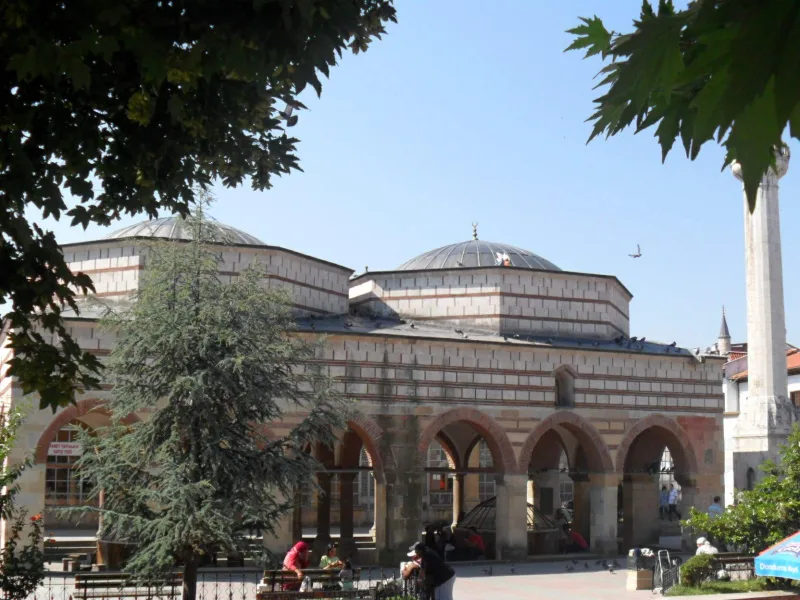
The Nasrullah Mosque was built in a style characteristic of provincial classical Ottoman architecture, tracing its roots to the school of the great architect Sinan and his students. The mosque’s floor plan is nearly square, featuring a large main hall covered by a system of domes and a spacious courtyard surrounded by a gallery.
Exterior and silhouette
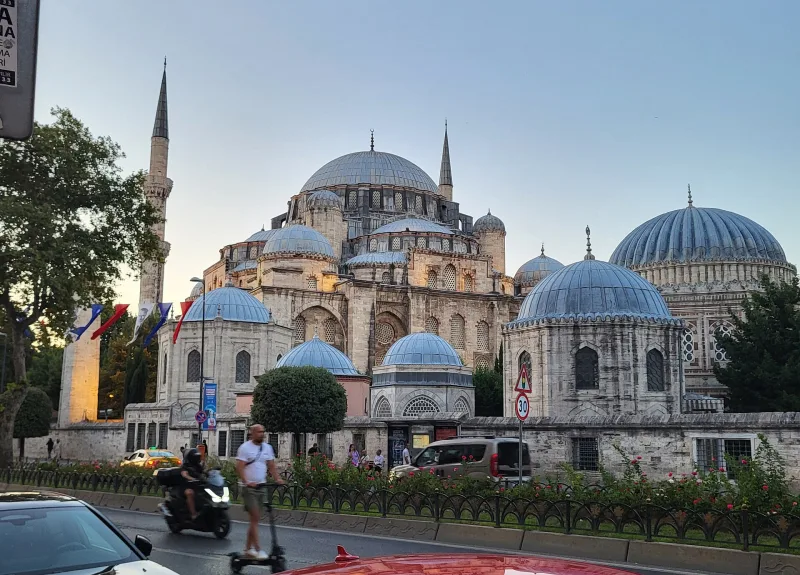
The main prayer hall is covered by two large domes arranged in sequence along a north–south axis, which is rare for provincial Ottoman mosques: a single central dome is more common. The pair of domes gives the mosque a distinctive silhouette, visible from any point in old Kastamonu. Adjacent to the building are two tall minarets, soaring gracefully into the sky. The minarets are constructed of clean-cut stone, featuring a balcony (sherif) encircled by a carved balustrade. The dome cornices are adorned with characteristic Ottoman “toothed” decoration, and the lead coverings reflect light at a unique angle, creating a shimmering effect at sunrise and sunset.
Interior
The prayer hall is strikingly spacious: the total interior area exceeds 800 square meters, and it can accommodate about two thousand worshippers. The domes rest on massive arches and mighty central pylons, creating a sense of lightness and upward aspiration—a signature feature of Ottoman imperial architecture. The walls and the space beneath the dome are covered with murals executed in the kalemkari technique—a traditional Ottoman style of wall painting featuring floral and calligraphic motifs in shades of blue, turquoise, and dark red. Many of the patterns were restored during the renovation, but some of the original 16th–18th-century murals have been preserved on the upper level.
Mihrab, Minbar, and Calligraphy
The main mihrab (prayer niche facing Mecca) is made of white marble, framed by columns, and adorned with a carved arch featuring a typical Ottoman “stalactite” muqarnas vault. Nearby stands a marble minbar—a pulpit for the preacher, crowned with a conical spire. The walls feature large medallions with calligraphic inscriptions of the names of Allah, the Prophet Muhammad, and the Four Rightly Guided Caliphs; these were executed by 19th-century Kastamonu masters in the Thuluth style.
Courtyard, Shadyrvan, and Portico
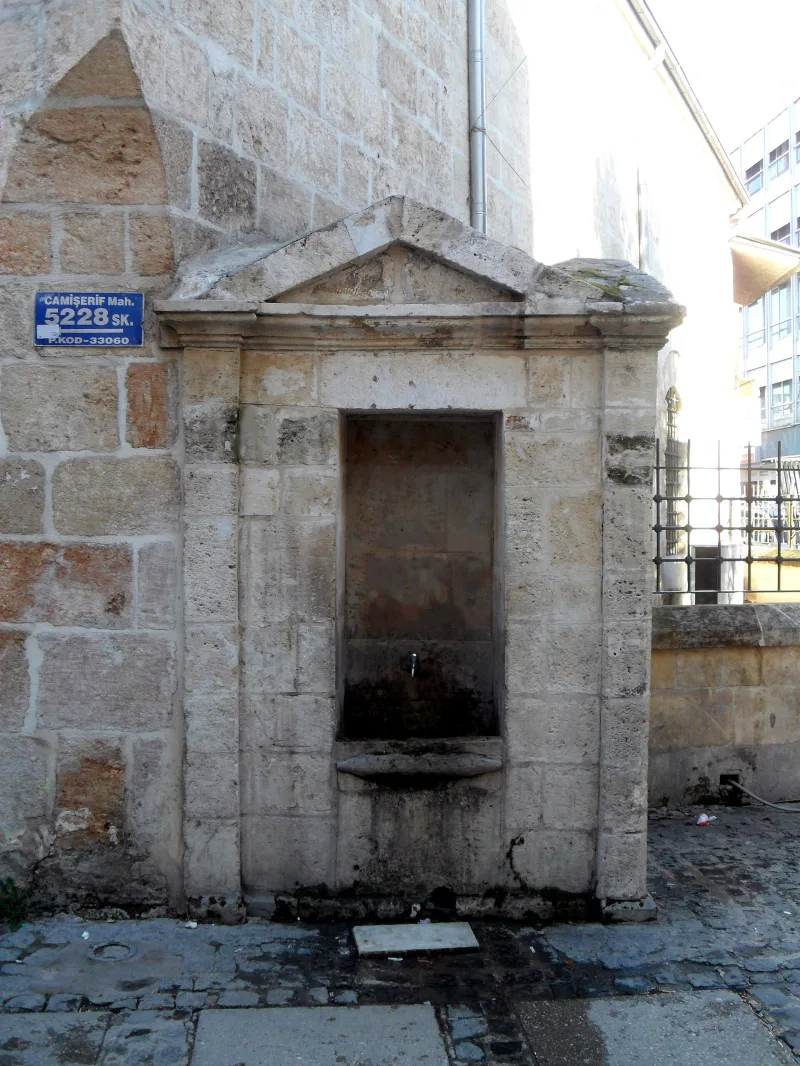
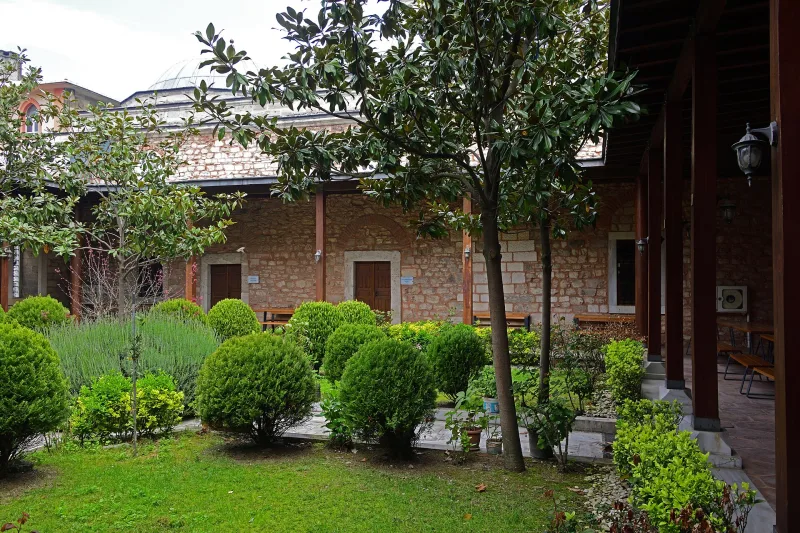
In front of the mosque’s entrance lies a spacious courtyard paved with slabs, in the center of which stands a shadyrvan—an octagonal fountain under a canopy for ritual ablutions. The fountain was rebuilt in the 18th century and is considered one of the most picturesque in Anatolia: its roof is supported by carved wooden columns, and water flows from several bronze spouts. Plane trees surround the courtyard, in whose shade elderly men spend entire days drinking tea and playing backgammon.
Nasrullah Square and the Surrounding Complex
The square surrounding the mosque is the historic heart of Kastamonu, protected as an urban monument. Here stand Ottoman shops from the 18th–19th centuries, where traditional siirak (copperware), leather, and local sweets are still sold, as well as the famous Kastamonu chekme—a thin, sweet paste made from tahini. A short distance away lies the Akkay Covered Market, the Ibn Nezzar Madrasa, and 15th-century stone bridges, all forming a unified historical landscape.
Interesting Facts and Legends
- The Nasrullah Mosque ranks among the ten largest historical mosques in Turkey by capacity and is the largest mosque in the Black Sea region.
- The founder’s name—Nasrullah Kadi—translates as “God’s help”; during the fires and earthquakes of the 19th century, the city’s residents prayed for its preservation, and the mosque survived all the disasters.
- There is a proverb in Kastamonu: “Without Nasrullah, there is no Friday”—indicating that Friday prayers were historically performed here.
- The wooden carvings on the minbar door were crafted without a single nail using the “kyundekari” technique, characteristic of the Seljuk and early Ottoman traditions.
- Beneath the mosque is a small crypt where, according to legend, Nasrullah Kadi himself is buried; the entrance is closed to visitors.
- In 1925, President Atatürk, who had announced his famous “reform” decree on new clothing in Kastamonu, attended Friday prayers at Nasrullah.
- The fount in the mosque courtyard serves as a gathering place for locals: it is believed that water from all the springs of Kastamonu Province is collected here.
How to get there
The city of Kastamonu is located in the northern part of Central Anatolia, 200 kilometers north of Ankara and 90 kilometers from the Black Sea coast. The city is easily accessible by intercity buses: trips from Ankara take 3–3.5 hours, and from Istanbul—8–9 hours. The Kastamonu bus station is connected to the city center by regular city buses and dolmuşes; it takes about 15 minutes by bus or 25 minutes on foot along the Kerbele River to reach Nasrullah Square from the bus station.
The nearest airport is Kastamonu (KFS), located 13 kilometers from the city; flights from Istanbul arrive here. An alternative is Ankara’s Esenboğa Airport, from which you can take a direct bus. The mosque itself is located in the heart of the old city, and any walk through the historic center of Kastamonu will inevitably lead you to its square. Parking around the mosque is limited; it is recommended to leave your car in the municipal underground parking garage and walk 10 minutes.
Tips for Travelers
The best time to visit is late spring (May–June) and early fall (September–October), when Kastamonu is mild and green. The city is known for its cool climate—even in summer, temperatures rarely exceed 28°C, and at night they drop to 15°C. In winter, Kastamonu is blanketed in snow, and the mosque looks particularly picturesque in its winter attire.
Admission to the mosque is free, but as it is an active religious building, it is best to visit outside of prayer times (5 times a day; the schedule is posted at the entrance). It is especially important to avoid the Friday noon prayer, when the mosque is crowded with worshippers. Women should cover their heads and shoulders (scarves are provided free of charge at the entrance), and men should wear long pants. Upon entering, you must remove your shoes and place them on special shelves or in plastic bags. Inside, it is prohibited to speak loudly, photograph worshippers, or record video without permission.
Allow 45–60 minutes to tour the mosque and its courtyard. After your visit, be sure to take a stroll through the area surrounding the old town: visit the Kastamonu House Museum, the Alai-Koshk Exhibition Area, the Kastamonu Fortress on the hill (which offers a panoramic view of the entire city), and the Narpus-Han Covered Market. Don’t miss the chance to sample the local cuisine: the pumpkin dessert “etli ekmek,” the local pasta “banduma,” sweet çökmeli helva, and strong tea made from bergamot grown in the surrounding villages. It is here, amidst this provincial beauty and warm Ottoman architecture, that you will best sense what Anatolia looked like in the days when Nasrullah Kadi laid the cornerstone of his cathedral mosque.