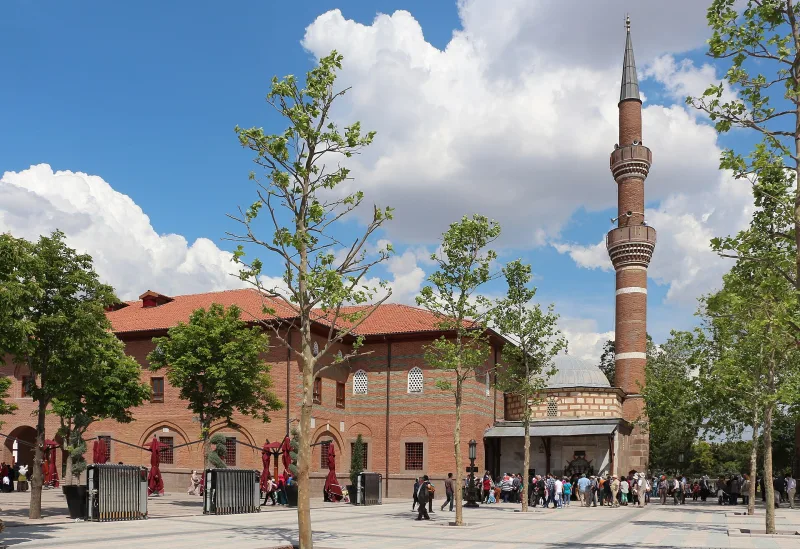
The Hacı Bayram Mosque in Ankara—a 15th-century shrine and türbe

Hacı Bayram Mosque: The Spiritual Heart of Old Ankara

On Ulus Hill, where the Roman temple of Emperor Augustus once stood, today stands the Hacı Bayram Mosque—Ankara’s main shrine and a place of pilgrimage for thousands of Muslims from all corners of Turkey. The mosque is built right next to the ancient temple; its stonework blends with the ruins of the Augusteum, forming a unique architectural ensemble where Roman antiquity coexists with Ottoman piety. Here lies Hacı Bayram-ı Veli—a 15th-century Sufi sheikh, founder of the Bayramiye order, and spiritual teacher to an entire generation of the Ottoman elite.

History of the Mosque and the Saint

The mosque was built in 1427–1428 during the reign of Sultan Murad II—shortly after the death of Hacı Bayram-ı Veli (around 1430). The sheikh himself, born in 1352 in the village of Solfasol near Ankara, was a disciple of Hamid Hamidüddin Aksarayî (Somuncu Baba) and eventually developed his own Sufi path—the Bayramiye—which had a profound influence on the spiritual life of the early Ottoman period. Among his disciples was Akşemseddin—the mentor of Sultan Mehmed II the Conqueror.

The mosque was built directly against the southeast wall of the ancient Temple of Augustus and Roma (Monumentum Ancyranum), on the facade of which the famous inscription Res Gestae Divi Augusti—the political testament of Octavian Augustus—has been preserved. The proximity of a pagan temple and an Islamic shrine is one of the most unusual in Turkey. Over the centuries, the mosque has been renovated numerous times: major renovations took place in the 17th–18th centuries, the minaret was renovated in the early 20th century, and major restoration work was carried out in the 1940s and 2010s. The Kutahya-made tilework was added in the 18th century.

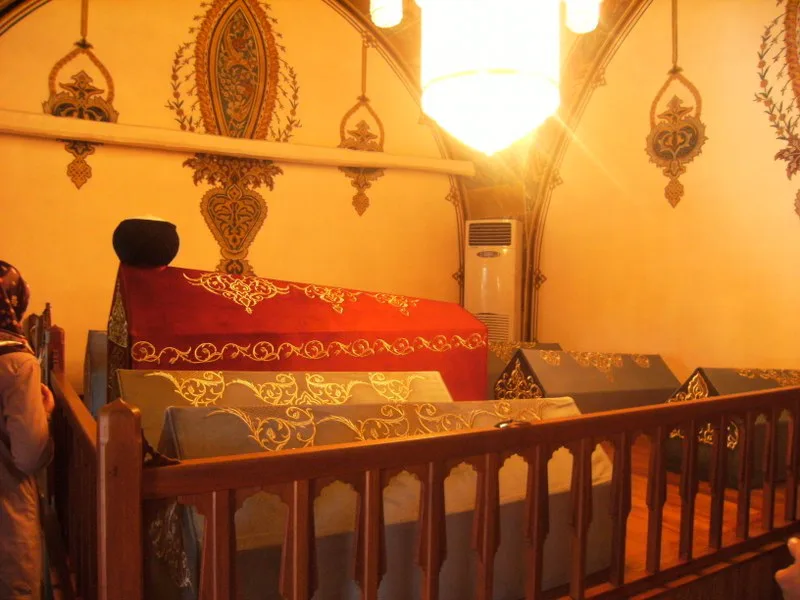
The Türbe (mausoleum) of Hacı Bayram-ı Veli is located right next to the mosque, in a small stone building with a dome. His son Ahmet Baba and a number of his followers are also buried here. The square in front of the mosque traditionally serves as a gathering place for pilgrims, especially on Fridays and religious holidays.

Architecture and What to See

Exterior and minaret

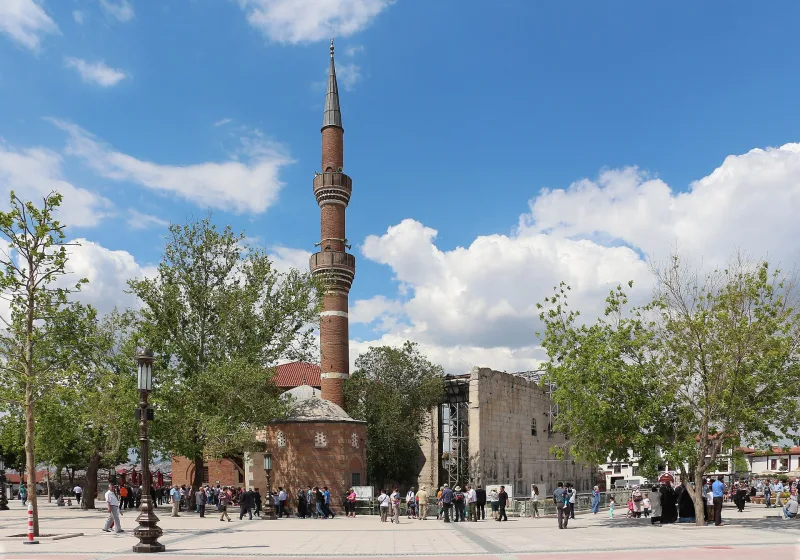
The mosque is a rectangular building constructed of hewn yellow-ochre stone and brick, covered with a tiled roof. The two-story composition—the lower level serving as the prayer hall and the upper level as a gallery—is characteristic of the early Ottoman Anatolian tradition. The single minaret, slender and graceful, rises on the northwest side and is clearly visible from afar. A spiral staircase leads to it, and the traditional şerefe (muezzin’s balcony) is decorated with carvings.

Prayer Hall and Mihrab

The interior is an oblong hall covered by a wooden ceiling supported by columns. The mihrab faces Mecca and is decorated in the traditional Ottoman style; next to it stands a wooden minbar with elegant carvings. The walls up to the level of the gallery are covered with 18th-century Kutahya ceramic panels: blue, turquoise, and white colors predominate, with patterns of floral arabesques and rosettes.

Türbe Hacı Bayram-ı Veli

The mausoleum adjoins the mosque on the southeast side and is accessible through a separate entrance. It is a small, single-domed building containing a coffin (a symbolic sarcophagus) covered with green cloth embroidered with verses from the Quran in gold. The room is always filled with pilgrims reciting du’a and the Quran.

Augusteum nearby

Just a few steps from the mosque stand the walls of the Roman Temple of Augustus and Roma (Monumentum Ancyranum)—one of Anatolia’s most important ancient monuments. It is here that the complete Latin and Greek text of the Res Gestae Divi Augusti—the autobiographical account of the first Roman emperor—is inscribed. A visit to the mosque and the temple is usually combined into a single outing.

Interesting Facts

  • Hacı Bayram-ı Veli is considered the patron saint of Ankara; according to local belief, his prayers protect the city.
  • The mosque is one of the few places in Turkey where an Islamic shrine and a Roman ancient temple form a single architectural complex.
  • Hacı Bayram was not only a Sufi but also a poet: his poems in Old Turkish have become part of the classical corpus of Anatolian mystical poetry.
  • A traditional neighborhood has developed around the mosque, known for its shops selling prayer beads (tesbih), halva, Turkish delight, and religious literature.
  • The Bayramiye Order gave rise to several major branches: Şemsiyye, Melamiyye, and Celvetiyye—the latter having a particularly significant influence on the spiritual life of 17th-century Istanbul.

How to get there

The mosque is located in the Ulus district, in the historic center of Ankara, just 1 km from Ulus Meydanı Square. The nearest metro station is Ulus (Ankaray/M1 line). It is about a 10–15-minute walk from the square along Hacı Bayram Caddesi. From the Ankara Garı train station, it is about 1.5 km away; it is convenient to walk or take a taxi.

Access by car is possible, but the streets in the old town are narrow and parking is limited. It is recommended to leave your car at one of the paid parking lots in the Ulus area. From Esenboğa Airport (ESB)—about 35 km; it is convenient to get there by Havaist or taxi.

Tips for travelers

Hacı Bayram Camii is an active mosque, so please observe the rules for visiting Muslim holy sites: remove your shoes at the entrance (shelves and bags are provided), women must cover their heads with a scarf, and shoulders and knees must be covered. Scarves are sometimes provided at the entrance, but it’s best to bring your own.

The best time to visit is between prayer times, outside of Friday prayer hours (cuma namazı around noon) and major religious holidays, when the mosque and square are crowded. Mornings on weekdays are the quietest. Türbe Hacı Bayram is open daily, and admission is free.

Don’t miss the nearby Monumentum Ancyranum—you can enter the ruins for free by walking around the mosque to the left. The combination of Roman antiquity and Ottoman Sufism creates a unique atmosphere found nowhere else in Turkey. After your visit, you can stroll through the nearby shops and sample traditional Anatolian sweets—especially tahin pekmez and helva.

Photography is permitted inside the mosque, but without a flash and not during prayer times. The best views of the complex are from the northwest corner, where the minaret, the türbe dome, and the ruins of the Temple of Augustus come together in a single composition.
Your comfort is important to us, click on the desired marker to create a route.
Meeting for minutes before
Yesterday. 17:48
Frequently asked questions — The Hacı Bayram Mosque in Ankara—a 15th-century shrine and türbe Answers to frequently asked questions about The Hacı Bayram Mosque in Ankara—a 15th-century shrine and türbe. Information about the service's operation, capabilities, and use.
Hacı Bayram-ı Veli (c. 1352–1430) was a Sufi sheikh, poet, and spiritual teacher born in the village of Solfasol near Ankara. He founded the Bayramiye Sufi order, which had a profound influence on the spiritual and cultural life of the early Ottoman period. Among his disciples was Akşemseddin, the mentor of Mehmed II the Conqueror. Hacı Bayram-ı Veli is considered the heavenly patron of Ankara, and his mausoleum near the mosque attracts thousands of pilgrims from all over Turkey every year.
No, admission to the Hacı Bayram Camii Mosque and the adjacent Hacı Bayram-ı Veli Mausoleum (Türbe) is completely free. The Türbe is open daily. Similarly, you can visit the ruins of the ancient Temple of Augustus (Monumentum Ancyranum), located right next to the mosque, at no charge.
Yes, the mosque is open to tourists of all faiths—provided they follow the rules for visiting Muslim holy sites. You must remove your shoes at the entrance; women must cover their heads and dress so that their shoulders and knees are covered. Headscarves are sometimes provided at the entrance, but it’s best to bring your own. Photography is permitted without a flash and not during prayer.
Monumentum Ancyranum is a 1st-century BCE Roman temple dedicated to Augustus and Roma, on whose walls is carved the complete Latin and Greek text of the Res Gestae Divi Augusti—the political testament of the first Roman emperor, Octavian Augustus. The Hacı Bayram Camii Mosque was built right up against the southeast wall of this temple in 1427–1428, creating a unique ensemble: Roman antiquity and Ottoman Islamic architecture literally touch one another. You can reach the ruins by walking around the mosque on the left.
The walls of the prayer hall, up to the level of the gallery, are covered with 18th-century ceramic panels produced in Kütahya. They are characterized by blue, turquoise, and white colors with patterns of floral arabesques and rosettes. Kütahya is the historical center of Turkish tile art, and these panels are among the most representative examples of this style in Ankara.
Bayramiye is a Sufi order founded by Hacı Bayram-ı Veli in the 15th century. The order exerted a significant influence on the spiritual life of the Ottoman Empire and gave rise to several major branches: Şemsiyye, Melamiyye, and Celvetiyye. The latter was particularly active in Istanbul during the 17th century. In addition to his religious practice, Hacı Bayram-ı Veli left a poetic legacy in Old Turkish, which became part of the classical corpus of Anatolian mystical poetry.
The quietest times are in the mornings on weekdays—after the morning prayer and before noon. You should avoid Friday noon (cuma namazı), when the mosque and the surrounding area are crowded. It is also crowded on major religious holidays—Eid al-Adha and Eid al-Fitr. The recommended seasons for a general tour of the Ulus district are spring and fall.
The area around Hacı Bayram Camii has historically developed into a commercial district with a religious character. Here you can find shops selling prayer beads (tesbih), halva (helva), Turkish delight, tahini-molasses spreads (tahin pekmez), religious literature, and souvenirs. It’s a great place to sample traditional Anatolian sweets and pick up some souvenirs.
Yes, in addition to the mosque itself and the Monumentum Ancyranum, the historic Ulus district—with its markets and old buildings—is located right nearby. A little further away are the Ankara Citadel (Ankara Kalesi) and the Museum of Anatolian Civilizations (Anadolu Medeniyetleri Müzesi), one of Turkey’s finest archaeological museums. All three sites can be combined into a single half-day walking tour.
The most striking view is from the northwest corner of the complex: from here, the slender minaret of the mosque, the dome of the Türbe, and the ancient walls of the Temple of Augustus all fit into a single frame. Photography is permitted inside the mosque, but only without a flash and not during prayer times.
User manual — The Hacı Bayram Mosque in Ankara—a 15th-century shrine and türbe The Hacı Bayram Mosque in Ankara—a 15th-century shrine and türbe User Guide with a description of the main functions, features, and principles of use.
The Hacı Bayram Camii Mosque is located in the Ulus district—the historic center of Ankara. The easiest way to get there is to take the metro to the Ulus station (Ankaray/M1 line), then walk about 10–15 minutes along Hacı Bayram Caddesi. It is about 1.5 km from the Ankara Garı train station—you can walk or take a taxi. If you are coming from Esenboğa Airport, take the Havaist bus or a taxi (about 35 km). If driving, be aware of the narrow streets in the old city: it is best to leave your car at a paid parking lot in the Ulus district.
Hacı Bayram Camii is an active mosque, so there are specific dress requirements. Women must cover their heads (with a scarf), shoulders, and knees. Men should also avoid wearing shorts. Shoes must be removed at the entrance—shelves and bags are provided for them. Headscarves are sometimes provided at the entrance, but it’s safer to bring your own. Prepare your clothing in advance, especially if you plan to visit during the warmer months.
Come on a weekday morning—after the morning prayer and before noon. This is the quietest time: there are few pilgrims, the hall is quiet, and you can take your time exploring the mihrab, the minbar, and the tile panels. Avoid Fridays around noon (Friday prayer) and major religious holidays—during these times, the mosque and the square in front of it are crowded.
Start with an exterior inspection: walk around the complex and observe how the mosque’s stonework abuts the ancient walls of the Temple of Augustus (Monumentum Ancyranum). The best spot for photos is the northwest corner, where the minaret, the dome of the mausoleum, and the ruins of the Roman temple align in a single line. Admission to the ruins is free—walk around the mosque on the left and examine the Latin and Greek text of the Res Gestae Divi Augusti on the walls.
After removing your shoes at the entrance, enter the oblong prayer hall with its wooden ceiling supported by columns. Note the mihrab facing Mecca, the carved wooden minbar, and the 18th-century Kutahya ceramic panels—blue, turquoise, and white, featuring floral arabesques. If a prayer service is in progress, wait at the entrance or observe quietly without disturbing those praying. Photography is permitted without a flash and outside of prayer times.
The mausoleum adjoins the mosque on the southeast side and has a separate entrance. Inside the small domed building is a sarcophagus (a symbolic coffin) covered with green cloth embroidered with verses from the Quran in gold. The son of Sheikh Ahmet Baba and his followers are also buried here. Admission is free, and it is open daily. Inside, pilgrims recite du’a and the Quran—please remain quiet and behave respectfully.
After exploring the complex, take a stroll through the surrounding streets: here you’ll find traditional shops selling prayer beads (tesbih), religious literature, Turkish delight, halva, and tahini-pekmez spreads. It’s a great place to buy authentic souvenirs and grab a bite to eat. The entire route—the mosque, Türbe, Monumentum Ancyranum, and the neighborhood—takes about 1.5 hours; if you wish, continue your walk to the Ankara Citadel (Ankara Kalesi) or the Museum of Anatolian Civilizations.