Site Camii: The Main Mosque of Modern Samsun
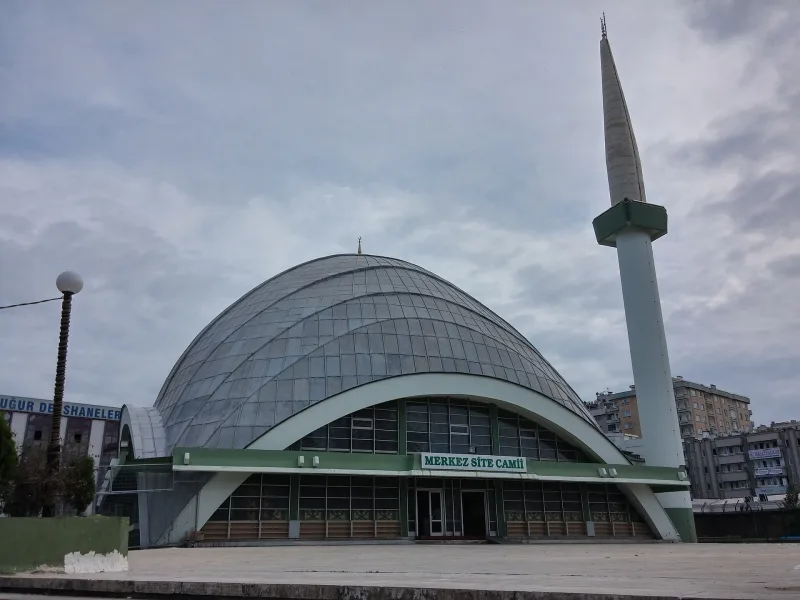
In the business and cultural heart of Samsun, on the shores of the Black Sea, stands one of the largest mosques on Turkey’s Black Sea coast—Site Camii, also known as Samsun Merkez Camii (“Samsun Central Mosque”). Built in the second half of the 20th century, it was conceived as the city’s main place of worship and, at the same time, as a modern architectural symbol of Samsun. Its spacious dome, four slender minarets, and expansive courtyard with fountains make it one of the most prominent landmarks in the city center.
History
The idea of building a large central mosque for Samsun had been discussed since the 1960s: the city was growing rapidly, the population had already exceeded several hundred thousand, and the existing historic mosques were insufficient for Friday prayers and major religious holidays. Design work on Site Camii began in the late 1970s, and construction continued for over a decade. The mosque was officially opened in 1995. The architects drew inspiration from examples of classical Ottoman architecture of the Sinan school, giving the structure a familiar silhouette with a central dome and soaring minarets.
Construction was funded by the city budget and private donations from worshippers. The mosque can accommodate up to 6,000 people at a time—making it one of the largest on Turkey’s Black Sea coast. Since its opening, Site Camii has served as the city’s main cathedral mosque: sermons are delivered here on major holidays, and ceremonies involving the city administration are held here.
Architecture and What to See
Dome Composition
Site Camii was built in the Neo-Ottoman style with clear references to the great 16th-century mosques of Istanbul. The central dome, with a diameter of about 27 meters, rests on four pillars; on either side are semi-domes that convey the central rhythm of the space. The interior is spacious and well-lit: numerous windows in the dome drum, walls, and semi-domes create soft, diffused light.
Minarets
The mosque has four minarets, located at the corners of the main structure. They are spire-shaped, with three şerefe (muezzin balconies) on each, which traditionally emphasizes the status of a central cathedral mosque. The minarets are about 60 meters tall. In the era before electronic megaphones, the muezzin would recite the azan from their tops; today, a sound system is used.
Mihrab, Minbar, and Calligraphy
The mosque’s mihrab is made of marble, featuring a traditional pointed niche and stalactite-shaped muqarnas. The minbar is also made of marble and decorated with carved panels. The walls and dome are covered with calligraphic compositions: verses from the Quran and the names of Allah, the Prophet Muhammad, and the Four Rightly Guided Caliphs predominate. The calligraphy was executed by contemporary masters in the tradition of the old Istanbul school.
Courtyard and Fountains
In front of the mosque is a large courtyard with fountains for ritual ablutions. The courtyard is surrounded by an arched gallery and is used for additional prayer during major holidays when the interior space is insufficient. The entrances to the library, ablution rooms, and a shop selling religious literature are also located here.
Interesting Facts
- Site Camii can accommodate up to 6,000 worshippers at a time—more than most of Turkey’s historic mosques.
- The four minarets, each with three şerefe, are a traditional feature of a sultan’s cathedral mosque, although Site Camii was built during the Republican era.
- The mosque became part of Samsun’s architectural modernization: a large public district with parks, banks, and shopping centers has formed around it.
- Despite the building’s modern age, Site Camii is stylistically inspired by the works of Sinan—primarily the Şehzade and Sultanahmet Camii in Istanbul.
- A huge circular chandelier, consisting of several tiers of lamps in the tradition of Ottoman mosques, hangs beneath the dome.
How to get there
The mosque is located in the very center of Samsun, in the İlkadım district, a few blocks from the Black Sea waterfront and Cumhuriyet Meydanı. It is about a 10-minute walk from the waterfront. The city is compact, and the mosque is within walking distance from anywhere in the center.
Samsun-Çarşamba Airport (SZF) is located 25 km east of the city center; it takes 30–40 minutes to reach Site Camii by taxi or HAVAŞ shuttle bus. Samsun Garı train station is 2 km from the center and can be reached by the Samsun T1 tram.
Public transportation around the city includes the T1 tram (Cumhuriyet station) and numerous city buses. Parking is available around the mosque, but it can be difficult during rush hour.
Tips for travelers
Site Camii is an active cathedral mosque, so please observe the rules when visiting: remove your shoes at the entrance (shelves and bags are provided); women must cover their heads with a scarf, and their shoulders and knees must be covered. Scarves are often provided at the entrance.
The best time to visit is between prayer times, in the morning on weekdays. Avoid Friday prayers (cuma namazı) and major religious holidays (Ramadan Bayram, Kurban Bayram), when the mosque is crowded. Tourists are welcome to enter freely; admission is free.
Inside, loud talking and the use of flash photography are prohibited. The panoramic views of the domed space and the calligraphic compositions in the area beneath the dome are particularly striking. From the outside, the best views of the complex are from the opposite side of the square at sunset.
Combine your visit with a walk along the Samsun waterfront, a visit to the Atatürk Museum, and the “Bandırma Vapuru” open-air museum—the ship on which Mustafa Kemal Atatürk arrived in Samsun on May 19, 1919, marking the beginning of the national liberation struggle. This event is considered the starting point of the modern Republic of Turkey.