The Evliya Kasım Pasha Mosque: A Forgotten Ottoman Gem on the Banks of the Tundzha River in Edirne
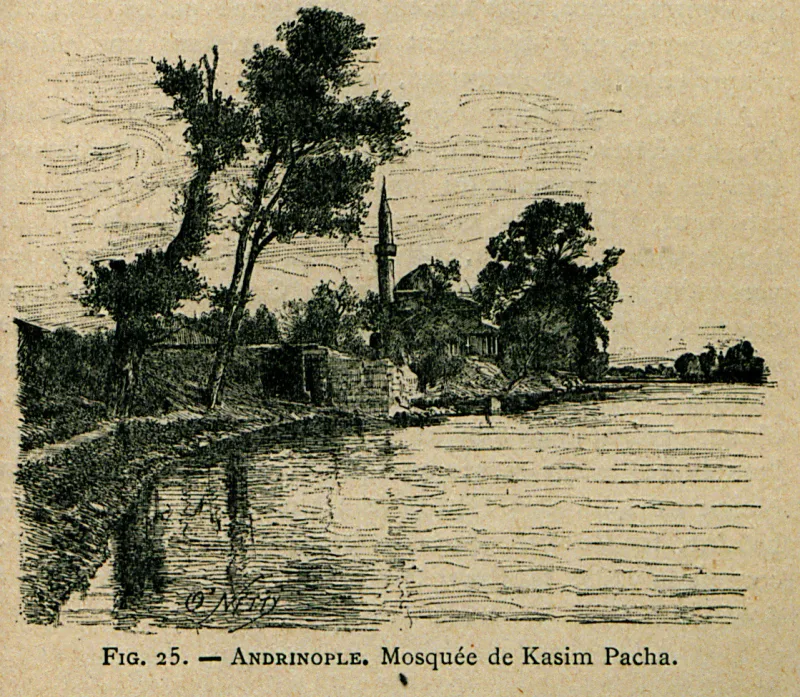
The Evliya Kasım Pasha Mosque stands on the northern bank of the Tundzha River, in the Kirishhane neighborhood, just south of Edirne’s historic center—and few 15th-century religious buildings tell such a dramatic story of a struggle against water, time, and oblivion. The Evliya Kasım Pasha Mosque was built in 1478–1479 by Kasım Pasha, the beylerbey of the Rumeli Eyalet, a military commander under Sultans Mehmed the Conqueror and Bayezid II, who was granted the title “Evliya” (“the Saint”) during his lifetime. Today, the square, single-domed mosque made of hewn stone stands in a green seclusion, separated from the city by an artificial dam, and since late 2024 has been undergoing a large-scale restoration, which is expected to restore it to its former glory by the end of 2026. A traveler willing to stray from the tourist trails of Selimiye and make their way here will witness a rare sight: early Ottoman architecture without gilding or crowds, in its nearly ruined authenticity.
History and Origin of the Evliya Kasım Pasha Mosque
The history of the monument begins in the mid-15th century, when the Ottoman Empire was experiencing one of its most vibrant decades. Kasim Pasha, who first appeared in the chronicles as early as 1442–1443, served as vizier first under Sultan Murad II, and then under his son, Mehmed II the Conqueror, who had just captured Constantinople. During an era when the empire was actively consolidating its hold on Rumelia—the European province encompassing the modern Balkans—it was Kasim Pasha who was appointed beylerbey, that is, the military and civil governor of this vast territory. He combined the sternness of a military commander with a reputation as a pious man: the title “Evliya,” meaning “saint,” was not bestowed upon every Ottoman dignitary.
The construction of the mosque in 1478–1479 coincided with the final years of Mehmed II’s reign and the beginning of Bayezid II’s reign. At that time, Edirne still retained the memory of its status as the former capital of the empire: it was from here that Mehmed II led his troops to Constantinople in 1453. The construction of a single-domed chamber mosque in a quiet neighborhood on the banks of the Tuna River appeared to be an act of personal piety. After his death, the pasha was buried in the courtyard of his own mosque—a hazire, as a small cemetery adjacent to a religious building is called in Turkish—and his tombstone remains one of the complex’s main relics.
For the next four centuries, the mosque functioned as a typical neighborhood mosque, serving the residents of the Kirishkhane district. Everything changed at the turn of the 20th century: the devastating earthquake of 1908 toppled the upper part of the minaret—the so-called “kaval,” the slender section of the shaft above the sherefe, the muezzin’s balcony. Restoration was delayed, and the river’s geology worked against the building: the Tundzha regularly overflowed its banks, and each flood carried away bits of masonry and plaster. In 1950, the authorities closed the mosque to worship and visitors—the key reasons being recurring floods and the shrinking of the community: an artificial dam, built to protect the center of Edirne, cut off the neighborhood from the city and accelerated the exodus of residents. For more than seventy long years, the mosque became a silent witness without worshippers.
Architecture and What to See
The monument belongs to the early Ottoman tradition of single-domed square mosques—still lacking the multi-domed cascades characteristic of the mature Sinan style of the 16th century. The simplicity of form is compensated here by the quality of the workmanship: the building is constructed of neatly hewn stone (ashlar), its walls are perfectly aligned, and the proportions of the interior space are thought out down to the smallest detail. Nearby is a single minaret and a small courtyard with the founder’s tomb.
Plan, Dome, and Materials
The building has a strictly square plan and is covered by a single dome—the classic “yek kubelli jami” layout, common in the 15th century. The facade faces north, and that is where the main entrance is located. The material deserves special attention: the entire structure is built of hewn stone blocks, unlike many contemporary buildings, which used a mixed brick-and-stone masonry. This gives the monument a more monolithic and austere appearance. The Son Jemaat Eri—the front portico where those who were late for the communal prayer would pray—has not survived to the present day; it was destroyed by water and the passage of time.
Facades, Windows, and Stone Stars
The northern facade is adorned with the main portal, above which is affixed a three-line architectural inscription in Ottoman Turkish—a kitabe. On either side of the entrance is an external mihrab flanked by two windows: this feature was necessary for praying outdoors when the inner hall was full. On the other three sides, there are four windows each, arranged in two rows. The lower windows are rectangular, set back into shallow niches, and crowned with pointed pediments; a small five-pointed star is carved into the center of each pediment. This modest, almost heraldic ornamentation transforms the facades into a stone night sky—a detail that is easy to miss if you don’t know where to look. The upper windows are arched, and in the middle of the western wall, a sundial remains, which once determined the time for prayer.
The Staircase to the River and the Minaret
A stone staircase of fourteen steps descended from the south side of the mosque, leading directly to the Tundzha: worshippers and travelers could come here by water. Today, only two steps remain of the staircase—the rest were destroyed by floods and silt deposits. Nevertheless, even this fragment gives a rare sense of the mosque’s former connection to the river. The single minaret has weathered much: in 1908, an earthquake knocked off its top, which was later partially restored. Currently, the minaret, like the entire building, is undergoing restoration.
The courtyard, hazire, and the tomb of Kasim Pasha
A small inner courtyard with green grass and several trees serves as a hazire—a family cemetery attached to the mosque. This is where the tomb of Evliya Kasim Pasha, the mosque’s founder, is located. The tombstone is crafted in the tradition of Ottoman vizier burials: a stone stele topped with a turban (signifying the deceased’s title) and an inscription in the “selus” style. For the traveler, this place becomes a logical stopping point: it is here that the historical figure for whom the mosque was built transforms from a name on a plaque into a real person. The silence of the courtyard is particularly striking in comparison to the bustling square near the Selimiye Mosque: there are no souvenir shops or tour groups here—only the rustling of willows by the river and the occasional footsteps of locals coming to tend to their ancestors’ graves.
Interesting Facts and Legends
- Kasim Pasha bore the honorary lifetime title “Evliya”—“saint.” In the Ottoman tradition, this title was bestowed upon dignitaries who combined public service with a reputation for deep piety; such a title is extremely rare.
- According to chronicles, in 1478 Kasim Pasha held the position of Beylerbey of the Rumelia Eyalet—one of the two key administrative units of the early Ottoman Empire, encompassing the Balkan provinces. For a governor of such rank, the construction of a personal mosque was a common practice, serving to perpetuate the memory of the donor.
- The five-pointed stars carved into the stone pediments of the lower windows are a rare decorative motif of the 15th century. They are often interpreted as a reference to Sufi symbolism, where the star is associated with night prayer and divine guidance.
- After 1950, when the mosque was closed, it became a local urban legend in Edirne: rumors circulated that during floods, voices reciting suras could be heard inside the building. Rationally, this is explained by the echo of the wind in the empty dome, but the legend persisted for decades.
- In the 2010s, provincial authorities considered two radical projects to save the monument: moving the Tünç Dam further away from the mosque or relocating the entire mosque to a safe location. Both options were rejected by the relevant agencies, and ultimately a third path was chosen—local hydraulic engineering combined with restoration.
How to get there
The mosque is located in the Kirishhane district in the southern part of Edirne, on the north bank of the Tuna River. The most convenient way to reach the city is by bus from Istanbul: regular buses depart from the Esenler bus station or the new Byzas Otogar and take 2.5–3 hours to reach the Edirne bus station. There is also a train route from Istanbul, but the bus is usually faster and cheaper. By car, the journey from Istanbul via the O-3/D-100 highway takes about 2.5 hours; in Edirne, there are convenient parking lots near the fortress gates and the Selimiye Mosque.
It is about 2 kilometers from the center of Edirne to the Evliya Kasım Pasha Mosque. You can walk from Selimiye in 25–30 minutes: head south toward the Tünç River, cross the historic Kanık Bridge, then follow the embankment to the Kirishhane neighborhood. A taxi from the center is inexpensive and takes 5–7 minutes. City buses and dolmus minibuses heading toward Karaağaç also pass nearby—get off at the sign for the Kirishhane neighborhood. Please note: during the restoration period (until the end of 2026), access to the building itself may be restricted; viewing is limited to the exterior, behind the construction fencing.
Tips for travelers
The best time to visit is late spring (May) and early fall (September–October), when the water level in the Tünç River is stable and the temperature is comfortable for walking through the green floodplain. In summer, the Kirishkhane neighborhood turns into a hot, almost shade-less area—bring water and a hat. In winter, the path to the mosque can get muddy after rain, so comfortable, waterproof shoes are a must. Allow 45–60 minutes for the site itself, plus travel time: this isn’t a place to pop in “for five minutes”; here, the rhythm of the quiet riverbank is what matters.
Combine your visit with the city’s main landmark—the Selimiye Mosque complex, the work of the great Mimar Sinan and a UNESCO World Heritage Site. A logical half-day itinerary: in the morning—Selimiye, then a walk down to the Tünç River, the Kanık Bridge, and a final stop at the Kasım Pasha Mosque. In Edirne, it’s also worth visiting the Bayezid II Complex (Bayezid II Külliyesi) with its unique Museum of the History of Medicine and the Old Mosque (Eski Camii). To a Russian-speaking traveler, the Kirishhane district will seem surprisingly similar to the river floodplains near Moscow—the same willow greenery, the same reflections of clouds in the slow-moving water, but with Ottoman stone instead of log cabins.
The rules for visiting religious sites in Turkey apply here even when the building is closed: women should carry a scarf, and clothing must cover the shoulders and knees. Photography from the outside is permitted and poses no issues; however, you should not fly a drone over the site—firstly, due to the proximity of the border with Greece and Bulgaria (airspace restrictions), and secondly, because of ongoing restoration work. If you’d like to bring back something more unique than the usual magnets from Edirne, stop by the old city bazaar for traditional honey-scented tulip-scented soap and the famous Edirne pastry “badem ezmesi”—marzipan made from local almonds. Once the work is completed in 2026, a partial opening to tourists is planned, but the schedule has not yet been confirmed—check the website of the General Directorate of Cultural Heritage of Turkey for updates before your trip. The Evliya Kasım Pasha Mosque is a rare example of how a forgotten 15th-century monument is being brought back to life through the efforts of a single province, and seeing it before its full restoration—in its carefully preserved state of ruinous authenticity—is a special, almost private experience that no other tourist hotspot in Edirne can offer.